Top AI Development Companies: Complete Evaluation Guide for 2026

Want to know more? — Subscribe
AI development companies build custom artificial intelligence systems for businesses. They create machine learning models, computer vision tools, natural…
AI development companies build custom artificial intelligence systems for businesses. They create machine learning models, computer vision tools, natural language processing applications, and automated AI solutions. Unlike companies that sell ready-made AI products (like OpenAI or Anthropic) or traditional software firms that just added "AI" to their services, real AI development firms build systems from scratch based on your specific data and business needs.
The global AI software market hit $154 billion in 2023, according to Gartner's AI market forecast. This growth means more companies need AI development partners who can turn AI capabilities into working systems. For CTOs, technical directors, and procurement teams, choosing the right AI development company means understanding what separates true AI engineering expertise from basic software consulting with an AI label.
Want a skimmable version?
Get a quick overview of our article with AI to access all the important information quickly.
Generate AI SummaryHide summary
Want a skimmable version?
Get a quick overview of our article with AI to access all the important information quickly.
Generate AI SummaryHide summaryA 2026 evaluation guide defining what a true AI development company is — core capabilities and criteria for choosing one.
What Defines a Top AI Development Company (And What Doesn't)
Not every company calling itself an AI development company actually builds AI systems. The market is crowded with traditional software consultancies rebranding existing services, system integrators adding pre-built AI modules, and agencies offering basic automation under the AI label.
A top AI development company is: a firm with dedicated AI/ML engineers, data scientists, and MLOps specialists who design custom models, build AI architectures from the ground up, and deploy systems that learn and improve from data. These companies handle the full development lifecycle—from data preparation and model training to production deployment and ongoing optimization.
What Top AI Development Companies Are NOT
Traditional Software Consultancies With "AI Services"
Many established software firms added AI to their service offerings without building specialized teams. They might integrate existing AI APIs or use low-code platforms, but they don't develop custom models or architect complex AI systems. According to MIT Technology Review's analysis of the AI services market, the majority of companies advertising AI capabilities actually provide integration services rather than custom development.
AI Product Companies
Companies like OpenAI, Anthropic, Google AI, and Hugging Face build AI products and platforms that others use. They're not AI development vendors you hire to build your custom system—they're the technology providers whose tools AI software development companies might leverage in your solution.
System Integrators Adding AI Modules
Large system integrators often add pre-packaged AI components to existing enterprise software. This isn't custom AI development—it's configuration and integration of existing tools. There's a place for this approach, but it's fundamentally different from building tailored AI systems.
Marketing Agencies Offering "AI-Powered" Tools
Some digital agencies rebrand basic automation, chatbots, or analytics dashboards as AI solutions. Real artificial intelligence development companies build systems that use machine learning algorithms, neural networks, and sophisticated data processing—not simple rule-based automation.
Core Capabilities That Define Leading AI Development Companies
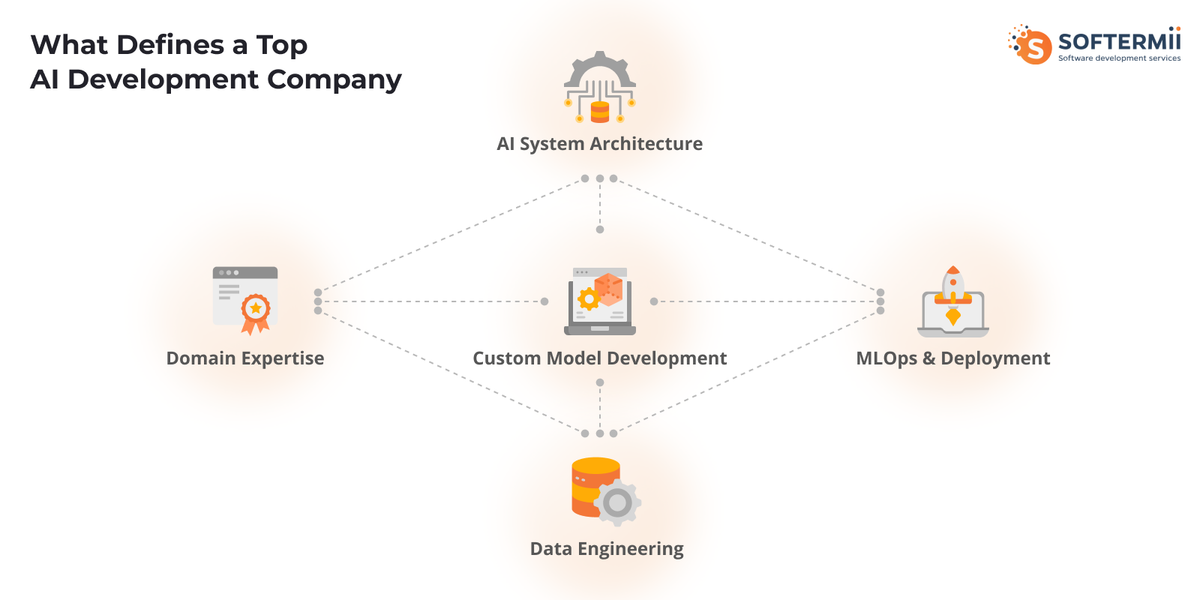
Custom Model Development
Top AI companies build machine learning models specific to your data and problem. This includes selecting appropriate algorithms, training models on your datasets, fine-tuning parameters, and validating performance. They don't just plug in pre-trained models—they develop solutions optimized for your use case.
AI System Architecture
Enterprise AI companies design complete system architectures that integrate AI components with your existing infrastructure. This includes data pipelines, model serving infrastructure, monitoring systems, and feedback loops that enable continuous improvement.
MLOps and Production Deployment
Leading AI development companies have strong MLOps capabilities—the practices and tools needed to deploy AI models reliably in production environments. This includes model versioning, automated testing, performance monitoring, and processes for updating models as data changes.
Domain Expertise
The best AI solution providers combine technical AI expertise with deep knowledge of specific industries. A healthcare AI system requires understanding of clinical workflows and regulatory requirements. Financial AI needs expertise in risk modeling and compliance. Generic AI knowledge isn't enough—top AI development companies bring relevant domain experience to your project.
Data Engineering Capabilities
AI systems are only as good as the data they're trained on. Strong AI development companies include data engineers who can clean, transform, and prepare data for model training. They understand data quality issues and can build pipelines that keep models fed with fresh, accurate information.
How to Evaluate AI Development Companies: Key Selection Criteria
Choosing an AI development partner requires evaluating both technical capabilities and business factors. Many companies look impressive on paper but lack the depth needed for complex AI implementations. This framework helps you assess AI development firms systematically.
Evaluation Framework for AI Development Companies
| Criterion | What to Assess | Why It Matters | How to Verify |
|---|---|---|---|
| AI/ML Technical Depth | In-house data scientists, ML engineers, research capabilities, model development experience | Determines if they can build custom solutions vs. just integrating existing tools | Ask about team composition, review technical case studies, request code samples or architecture diagrams |
| Industry-Specific Experience | Projects in your sector, understanding of domain challenges, regulatory knowledge | Generic AI expertise fails without industry context—healthcare, finance, and manufacturing have unique requirements | Check client roster, request relevant case studies, verify regulatory compliance experience |
| Deployment & Scaling Capabilities | MLOps practices, cloud infrastructure expertise, production monitoring, performance optimization | Models that work in testing often fail in production without proper deployment practices | Inquire about MLOps tools used, ask about model performance in production, check infrastructure partnerships |
| Data Engineering Capabilities | Data pipeline development, ETL processes, data quality management, feature engineering | AI quality depends entirely on data quality—weak data engineering undermines everything | Ask about data preparation approaches, request examples of data architecture, verify data governance practices |
| Post-Deployment Support | Model monitoring, retraining processes, performance maintenance, ongoing optimization | AI models degrade over time without maintenance—support determines long-term success | Review support SLAs, ask about monitoring practices, check maintenance pricing structure |
| Transparency & Explainability | Model interpretability, decision explanation capabilities, documentation quality | Regulatory requirements and business trust require understanding why AI makes specific decisions | Request documentation samples, ask about explainability methods (SHAP, LIME), verify audit trail capabilities |
| Security & Compliance | Data protection practices, compliance certifications (SOC 2, HIPAA, GDPR), security protocols | AI systems handle sensitive data—security failures create catastrophic risks | Verify certifications, review security assessments, check data handling policies |
| Communication & Collaboration | Project transparency, stakeholder engagement, technical communication skills | AI projects fail more often from misalignment than technical issues | Assess during initial conversations, request references about communication quality |
| Technology Stack & Tools | Frameworks used (TensorFlow, PyTorch), cloud platforms, MLOps tools, development practices | Modern tools and practices indicate current expertise vs. outdated approaches | Ask about preferred technology stack, verify cloud platform expertise, check framework proficiency |
| Portfolio Quality | Complexity of past projects, measurable outcomes, diversity of use cases | Past performance indicates capability to deliver on your project | Review detailed case studies, ask for performance metrics, verify client outcomes |
Technical Capability Assessment
When evaluating AI engineering companies, focus on these technical indicators:
Model Development Expertise: Can they explain trade-offs between different modeling approaches? Do they understand when to use deep learning vs. traditional ML vs. ensemble methods? Top AI software development companies make informed technical decisions based on your specific requirements, not trendy buzzwords.
Infrastructure Knowledge: Modern AI development requires cloud infrastructure expertise. The best AI technology companies work fluently with AWS SageMaker, Google Cloud AI Platform, or Azure ML, and can design cost-effective, scalable architectures.
End-to-End Capability: Some AI development vendors excel at model building but lack deployment skills. Others handle deployment well but struggle with complex modeling. Leading AI development companies cover the complete pipeline from data to production, according to Forrester's evaluation of AI service providers.
Research Capabilities: Companies that contribute to AI research, publish papers, or participate in ML competitions demonstrate technical depth beyond basic implementation skills.
Business Capability Evaluation
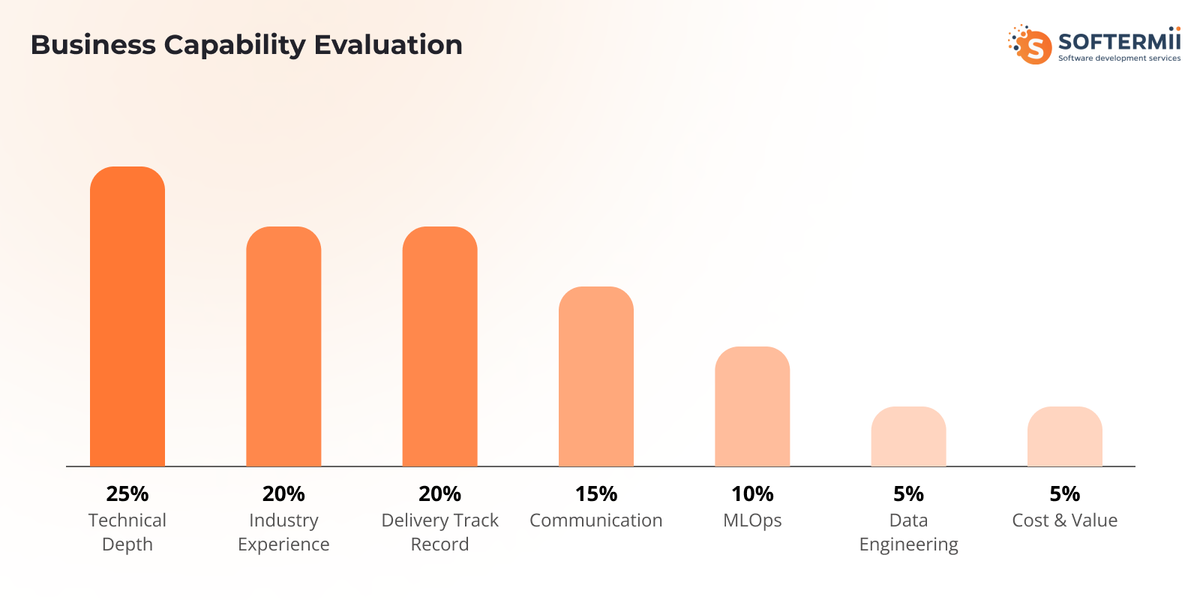
Technical skills alone don't guarantee project success. Assess these business factors:
Project Management Maturity: How do they handle scope changes, timeline adjustments, and stakeholder communication? AI projects involve uncertainty—rigid project management fails.
Change Management Support: AI implementations affect workflows and roles. Strong AI consulting and development firms help organizations adapt to new AI-powered processes.
ROI Understanding: Can they articulate expected business outcomes? Do they help define success metrics? The best enterprise AI solutions providers connect technical work to business value.
Partnership Approach: Are they order-takers or strategic partners? Top AI development companies challenge assumptions, suggest alternatives, and push back when requirements don't align with AI capabilities.
Categories of AI Development Companies
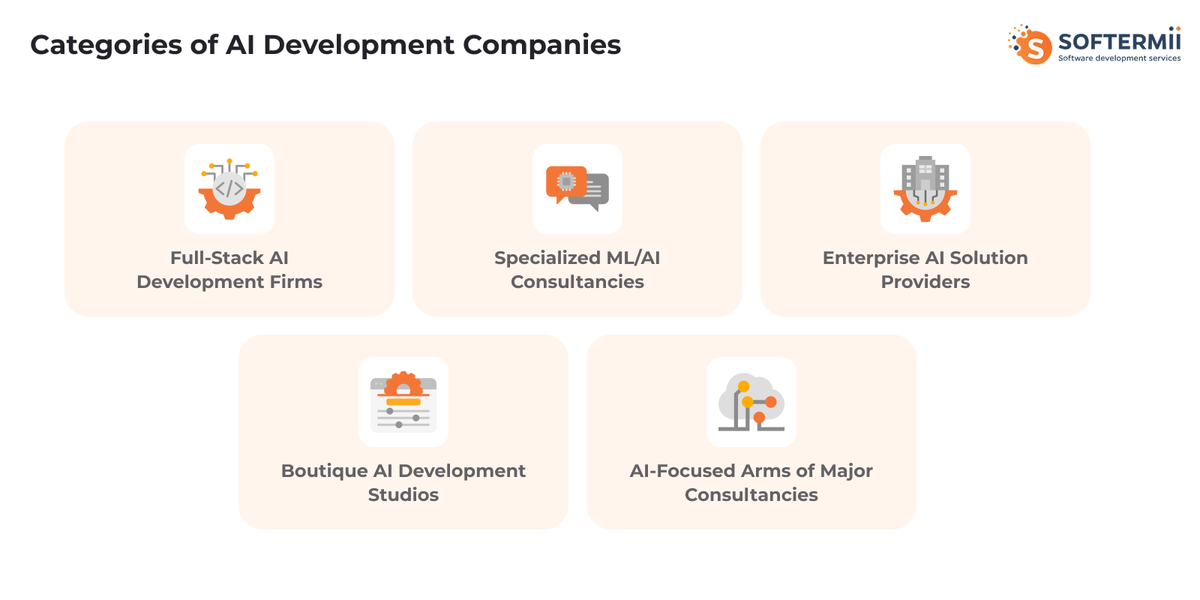
AI development companies fall into distinct categories based on their structure, capabilities, and target clients. Understanding these categories helps you identify which type matches your project scope, budget, and organizational needs.
Full-Stack AI Development Firms
These companies handle everything from initial data assessment through production deployment and maintenance. They employ data scientists, ML engineers, data engineers, MLOps specialists, and AI architects under one roof.
When to choose them: Complex projects requiring custom model development, system integration, and ongoing support. Best for organizations building strategic AI capabilities that need long-term partnership.
Typical project scope: 6-18 month engagements, $500K-$5M+ budgets, enterprise-scale deployments with multiple integrated systems.
Cost and resource implications: Higher upfront investment but eliminates coordination overhead of managing multiple vendors. Single point of accountability for entire AI system.
Examples: Large projects like building a complete fraud detection platform, developing custom recommendation engines with real-time personalization, or creating predictive maintenance systems for manufacturing operations.
Specialized ML/AI Consultancies
Boutique firms focused purely on machine learning and AI, often founded by former researchers or engineers from major tech companies. They bring deep technical expertise but may have smaller teams.
When to choose them: Projects requiring cutting-edge ML techniques, novel approaches to complex problems, or specialized capabilities like reinforcement learning or generative AI.
Typical project scope: 3-12 month engagements, $200K-$2M budgets, focused on specific technical challenges rather than complete system buildouts.
Cost and resource implications: Premium hourly rates ($200-$400+) but exceptional technical depth. May need separate vendors for infrastructure and deployment.
Examples: Developing novel computer vision algorithms for quality inspection, building custom NLP models for domain-specific language understanding, or creating advanced forecasting models using specialized techniques.
Enterprise AI Solution Providers
Companies that combine AI development with enterprise software expertise. They understand large organization dynamics, compliance requirements, and integration with existing enterprise systems.
When to choose them: Organizations with complex IT environments, strict compliance requirements, or existing relationships with major technology vendors.
Typical project scope: 12-24 month implementations, $1M-$10M+ budgets, extensive change management and training components alongside technical development.
Cost and resource implications: Highest total cost but includes comprehensive support, training, and enterprise-grade security. Best for risk-averse organizations.
Examples: Implementing AI-powered supply chain optimization across global operations, deploying enterprise-wide intelligent automation platforms, or building compliant AI systems for regulated industries.
Boutique AI Development Studios
Small, agile teams (10-50 people) offering personalized service and flexible engagement models. Often specialize in specific industries or use cases.
When to choose them: Mid-sized companies wanting hands-on partnership, startups building AI products, or organizations testing AI before major investments.
Typical project scope: 2-6 month projects, $100K-$500K budgets, focused solutions addressing specific business problems.
Cost and resource implications: Lower costs with faster iteration cycles. Less bureaucracy but fewer resources for large-scale deployments.
Examples: Building AI chatbots for customer service, developing pricing optimization models, creating content recommendation systems, or implementing automated document processing.
AI-Focused Arms of Major Consultancies
Traditional consulting firms (Accenture, Deloitte, McKinsey, BCG) have built dedicated AI practices combining strategy consulting with technical implementation.
When to choose them: Organizations needing business strategy alongside technical development, companies with existing consulting relationships, or projects requiring global delivery capabilities.
Typical project scope: 6-18 months, $500K-$10M+ budgets, heavy emphasis on organizational transformation and executive education.
Cost and resource implications: Premium pricing includes strategic advisory and change management. Technical depth varies—some leverage partner firms for actual development.
Examples: AI-driven business transformation programs, developing AI strategies with pilot implementations, or large-scale automation initiatives across multiple business units.
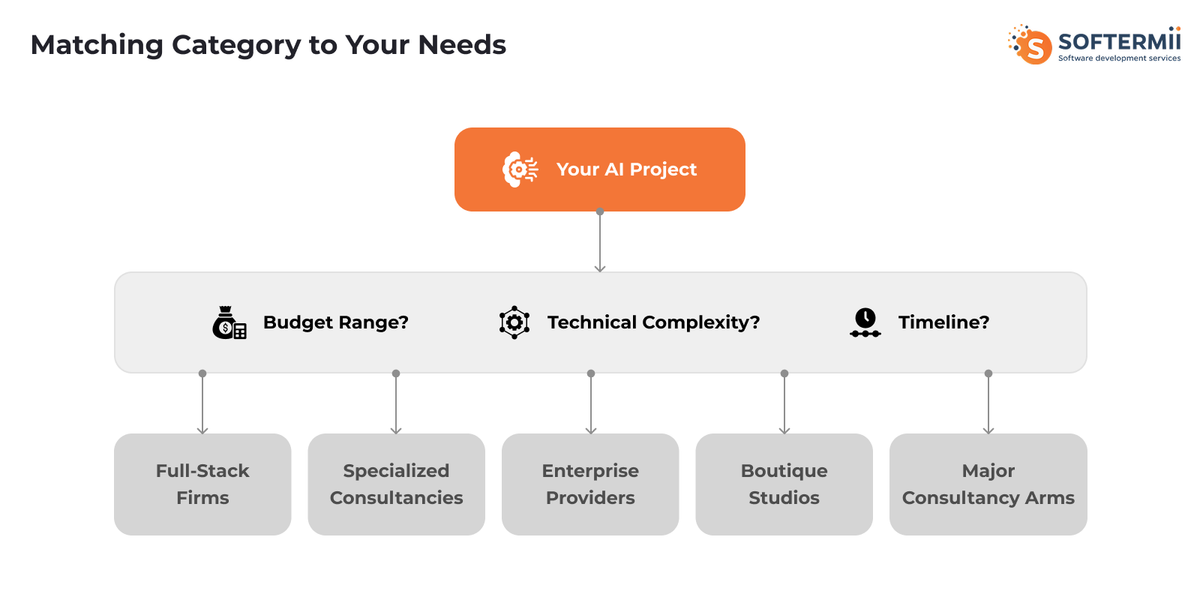
Matching Category to Your Needs
Your choice depends on several factors:
Project complexity: Simple automation suits boutique studios. Novel AI research needs specialized consultancies. Enterprise-wide transformation requires full-stack firms or major consultancies.
Internal capabilities: Strong internal teams can work with specialized consultancies focused on specific gaps. Organizations with limited AI expertise need full-stack providers offering comprehensive support.
Budget and timeline: Boutique studios offer faster starts and lower costs. Enterprise providers require larger budgets but reduce implementation risk.
Risk tolerance: Conservative organizations prefer enterprise solution providers or major consultancies with extensive track records. Innovative companies comfortable with uncertainty can benefit from specialized consultancies' cutting-edge approaches.
Top AI Development Companies by Capability & Specialization
This section provides a factual overview of AI development companies organized by their primary capabilities and market focus. The comparison is based on publicly available information, verified case studies, and documented technical capabilities.
Comparison Table: AI Development Companies by Capability
| Company | Core AI Capabilities | Industry Specializations | Typical Project Size | Key Differentiators |
|---|---|---|---|---|
| Softermii | Custom ML models, Computer vision, NLP solutions, Predictive analytics, AI system integration | Healthcare, Fintech, Retail, Logistics | $10K-$1M+ | Full-cycle development, MLOps expertise, transparent communication, flexible engagement models |
| DataRobot Partners | Automated ML, Model deployment, Enterprise AI platforms | Financial services, Insurance, Manufacturing | $500K-$5M | AutoML platform integration, enterprise focus |
| Element AI (ServiceNow) | Enterprise AI solutions, Workflow automation | Multi-industry enterprise | $1M-$10M+ | ServiceNow integration, enterprise scale |
| Quantiphi | Computer vision, NLP, Cloud AI solutions | Healthcare, Retail, Media | $250K-$3M | Google Cloud AI specialty, strong delivery track record |
| Fusemachines | Deep learning, Custom AI applications | Education, Healthcare, Finance | $150K-$2M | AI talent development, emerging market focus |
Enterprise-Scale AI Developers
Softermii
Softermii is a custom AI development services provider specializing in building end-to-end artificial intelligence solutions for mid-sized to enterprise clients. Founded with a focus on practical AI implementation, the company handles the complete development lifecycle from initial data assessment through production deployment and ongoing optimization.
Core AI Capabilities:
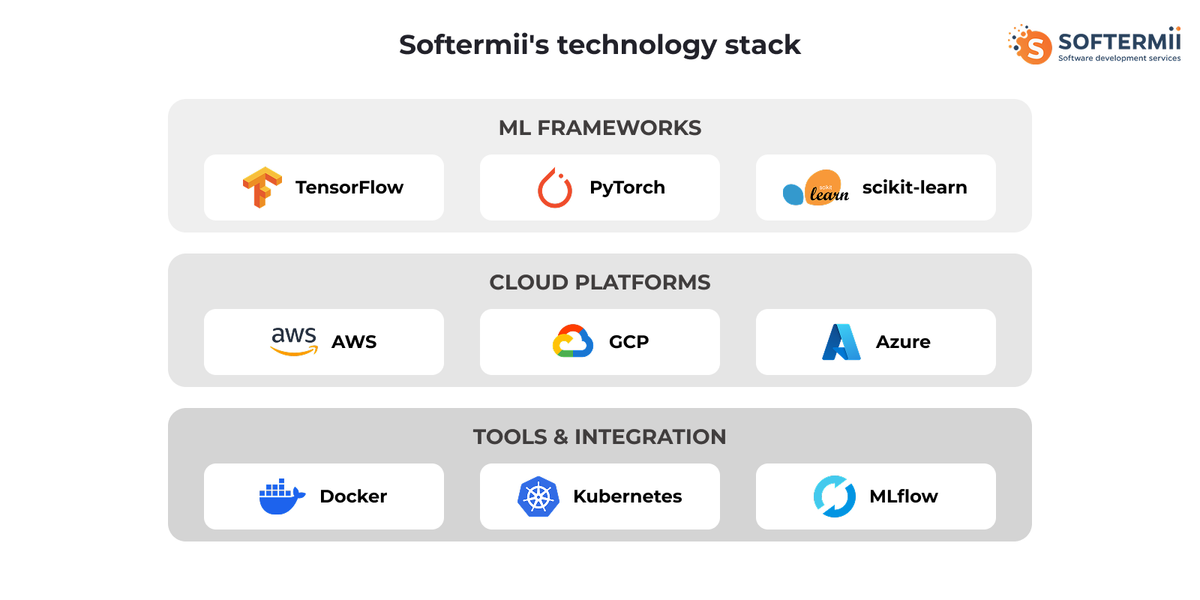
Softermii's technical team includes data scientists, ML engineers, and MLOps specialists who work across multiple AI disciplines. Their primary capabilities include:
- Custom Machine Learning Models: Development of supervised and unsupervised learning models tailored to specific business problems, including classification, regression, clustering, and anomaly detection systems
- Computer Vision Solutions: Image recognition, object detection, facial recognition, quality inspection systems, and automated visual analysis for manufacturing and retail applications
- Natural Language Processing: Text analysis, sentiment analysis, document processing, chatbots, and language understanding systems for customer service and content management
- Predictive Analytics Platforms: Forecasting models for demand prediction, risk assessment, customer behavior analysis, and operational optimization
- AI System Integration: Connecting AI models with existing enterprise systems, databases, and workflows to create seamless intelligent operations
Technology Stack:
Softermii works with modern AI development frameworks and cloud platforms:
- ML Frameworks: TensorFlow, PyTorch, scikit-learn, Keras
- Cloud Platforms: AWS (SageMaker, Lambda, EC2), Google Cloud Platform (AI Platform, AutoML), Microsoft Azure (Azure ML)
- Programming Languages: Python, R, Java, JavaScript
- Data Processing: Apache Spark, Pandas, NumPy, SQL databases, NoSQL solutions
- MLOps Tools: Docker, Kubernetes, MLflow, Apache Airflow for model deployment and monitoring
- APIs and Integration: RESTful APIs, GraphQL, microservices architecture
Industry Specializations:
Healthcare & Medical AI: Softermii has developed AI solutions for healthcare providers focusing on patient data analysis, medical image processing, and operational efficiency. Projects include predictive models for patient risk assessment and automated processing of medical documentation.
Fintech & Financial Services: The company builds fraud detection systems, credit risk models, and automated trading analytics for financial institutions. Their solutions help banks and fintech companies identify suspicious transactions and assess lending risk.
Retail & E-commerce: Softermii creates recommendation engines, inventory optimization systems, and customer behavior analysis tools. Their retail clients use AI for personalized shopping experiences and demand forecasting.
Logistics & Supply Chain: Projects include route optimization algorithms, delivery time prediction models, and warehouse automation systems that improve operational efficiency.
Real Client Cases:
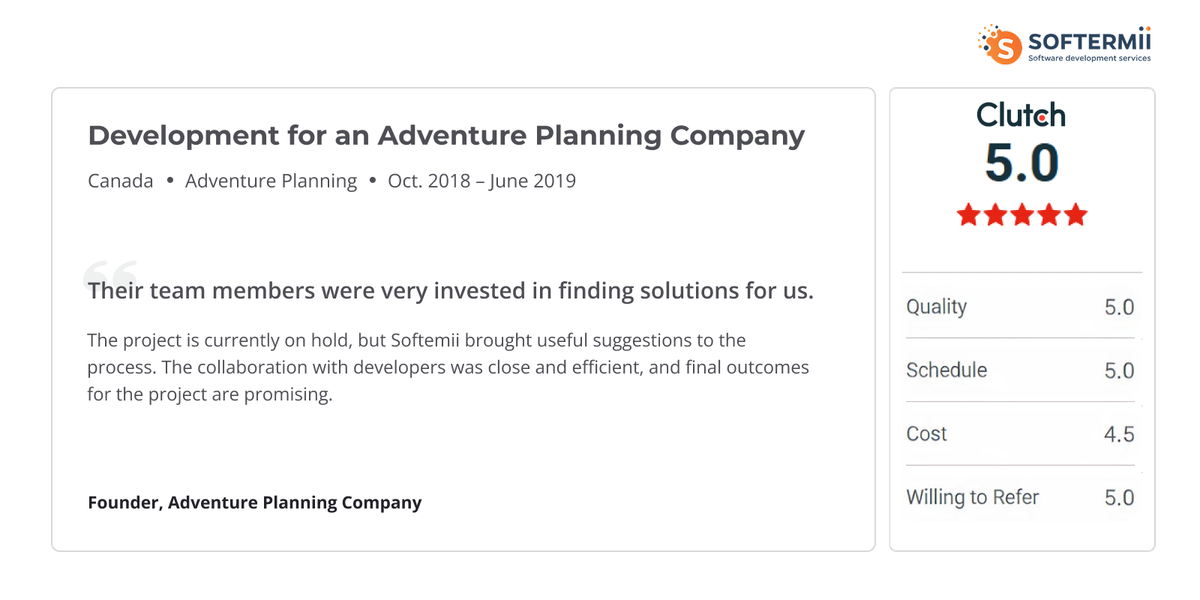
Healthcare Diagnostic Support System: Softermii developed a computer vision solution for a medical imaging company that analyzes X-rays and MRI scans to identify potential abnormalities. The system uses convolutional neural networks trained on thousands of labeled medical images. Implementation reduced initial screening time by 40% while maintaining high accuracy rates. The solution integrates with existing PACS systems and provides radiologists with highlighted areas of interest.
Financial Fraud Detection Platform: For a European fintech company, Softermii built a real-time fraud detection system processing thousands of transactions per second. The ML model uses ensemble learning techniques combining decision trees, neural networks, and anomaly detection algorithms. The system achieved a 35% reduction in false positives compared to the client's previous rule-based system while catching 22% more fraudulent transactions.
Retail Demand Forecasting System: A multi-location retail chain engaged Softermii to build a predictive analytics platform for inventory management. The solution analyzes historical sales data, seasonal trends, promotional calendars, and external factors like weather and local events. Implementation reduced stockouts by 28% and excess inventory by 19%, directly improving the client's bottom line.
Logistics Route Optimization: Softermii developed an AI-powered routing system for a logistics company managing last-mile deliveries. The solution uses reinforcement learning to optimize delivery routes in real-time based on traffic conditions, delivery windows, and vehicle capacity. The system reduced fuel costs by 15% and improved on-time delivery rates from 87% to 94%.
Client Testimonials:
"We were impressed with their willingness and flexibility to work with our internal processes and employees. Through their knowledge and technical expertise, the Softermii team delivered a final product according to specifications. They followed an agile process and showcased tremendous flexibility and dedication to ensure a seamless customer experience. The team also listened to instructions well." — CTO, Mediconnect
Best Suited For:
Softermii works best with mid-sized companies and enterprise divisions that need custom AI solutions but want a collaborative, transparent development partner. Ideal clients have clear business problems, reasonable data availability, and internal stakeholders ready to engage with the development process. The company's flexible engagement models accommodate both fixed-scope projects and ongoing partnerships.
Engagement Models:
- Project-Based: Fixed scope and budget for well-defined AI implementations
- Time & Materials: Flexible approach for exploratory projects or evolving requirements
- Dedicated Team: Extended engagement with dedicated AI specialists integrated into client operations
- Consulting & Advisory: Technical assessment, AI strategy development, and feasibility analysis before full implementation
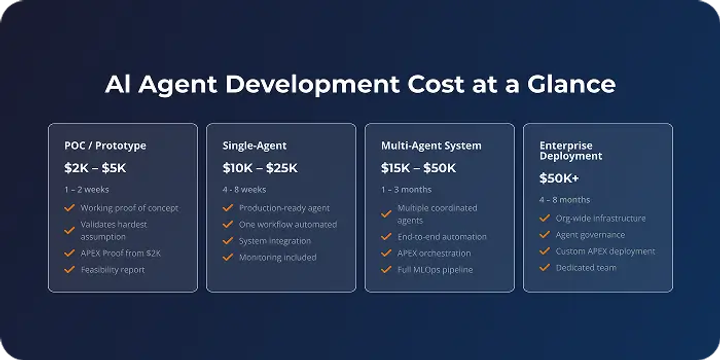
For startups and fast-moving tech companies, Softermii also offers APEX Agentic AI Engineering—a productized development approach that accelerates AI implementation through multi-agent orchestration. Unlike traditional development where teams manually coordinate work, APEX uses specialized AI agents (research, architecture, security, quality engineering) working through quality-gated workflows to deliver MVPs in 4 weeks instead of 3-6 months.
The system includes modular packages from proof-of-concept validation (starting at $1,000, 3 days) through production-ready builds (from $2,000, 4 weeks) to scaling support. APEX is particularly suited for first-time founders validating concepts quickly, funded startups needing rapid execution without agency bloat, and teams requiring transparent, sprint-based delivery with enterprise-grade security. Learn more about APEX Agentic AI Engineering.
Typical Project Timeline: 2-6 months from initial discovery through production deployment, with ongoing support and optimization available post-launch.
Mid-Market AI Development Firms
DataRobot Partners Network
Companies certified in DataRobot's automated machine learning platform, focusing on rapid model development and deployment for mid-market enterprises. These partners combine DataRobot's AutoML capabilities with custom development and integration services.
Core capabilities: Automated feature engineering, model selection, deployment automation, enterprise ML platform implementation
Best suited for: Organizations wanting faster time-to-value with automated ML approaches, companies with limited internal data science teams
Typical project size: $250K-$2M, 4-8 month implementations
Quantiphi

A machine learning development company specializing in Google Cloud AI solutions with strong capabilities in computer vision and NLP. Quantiphi has delivered over 300 AI projects across multiple industries.
Core capabilities: Google Cloud AI Platform expertise, custom computer vision models, conversational AI, big data analytics with AI
Industry focus: Healthcare (medical imaging), retail (visual search), media and entertainment (content analysis)
Best suited for: Organizations committed to Google Cloud infrastructure, projects requiring computer vision or video analytics
Typical project size: $250K-$3M, 6-12 month engagements
Fusemachines
AI development firm focused on deep learning applications with an emphasis on AI education and talent development alongside client projects.
Core capabilities: Deep learning models, neural network architectures, custom AI applications, AI workforce training
Industry focus: Education technology, healthcare diagnostics, financial services
Best suited for: Organizations wanting to build internal AI capabilities while implementing solutions, emerging market deployments
Typical project size: $150K-$2M, 4-10 month projects
Industry-Specialized AI Companies
Arterys (Medical Imaging AI)
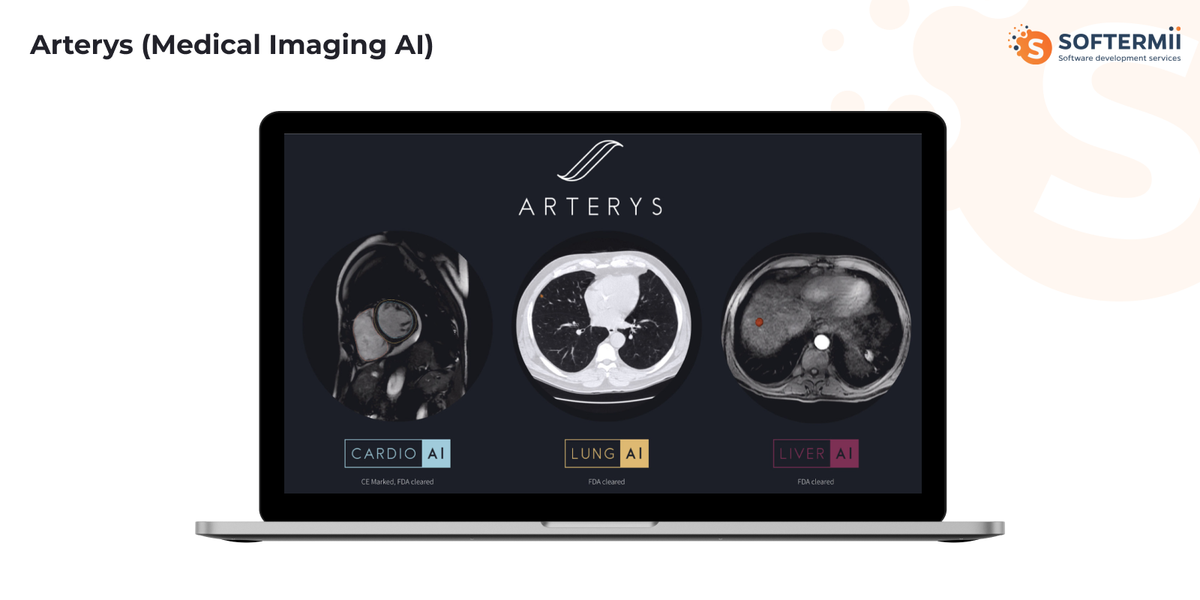
Specialized in medical imaging AI with FDA-cleared algorithms for cardiology, oncology, and radiology applications.
Core capabilities: Medical image analysis, diagnostic support systems, regulatory-compliant AI for healthcare
Best suited for: Healthcare providers and medical device companies needing FDA/CE-approved AI solutions
Kensho (Financial AI - S&P Global)
Fintech AI developers focused on financial data analysis, market intelligence, and investment research automation.
Core capabilities: Financial document analysis, market prediction models, automated research systems
Best suited for: Financial institutions, investment firms, asset managers needing specialized financial AI
Emerging AI Development Companies
Turing
AI-powered talent matching platform that also provides AI development capabilities through its vetted network of AI engineers and data scientists.
Core capabilities: Flexible staffing for AI projects, access to global AI talent, project-based and staff augmentation models
Best suited for: Companies needing rapid team scaling, startups building AI products, organizations testing AI before full commitments
Typical project size: $50K-$500K, 2-6 month engagements with flexible team composition
Labelbox (Data Labeling + AI Development)
Company specializing in training data creation with expanding AI development services for computer vision and NLP projects.
Core capabilities: Training data preparation, computer vision model development, annotation workflow automation
Best suited for: Projects requiring large-scale data labeling alongside model development, companies building proprietary datasets
AI Development Companies by Industry Specialization
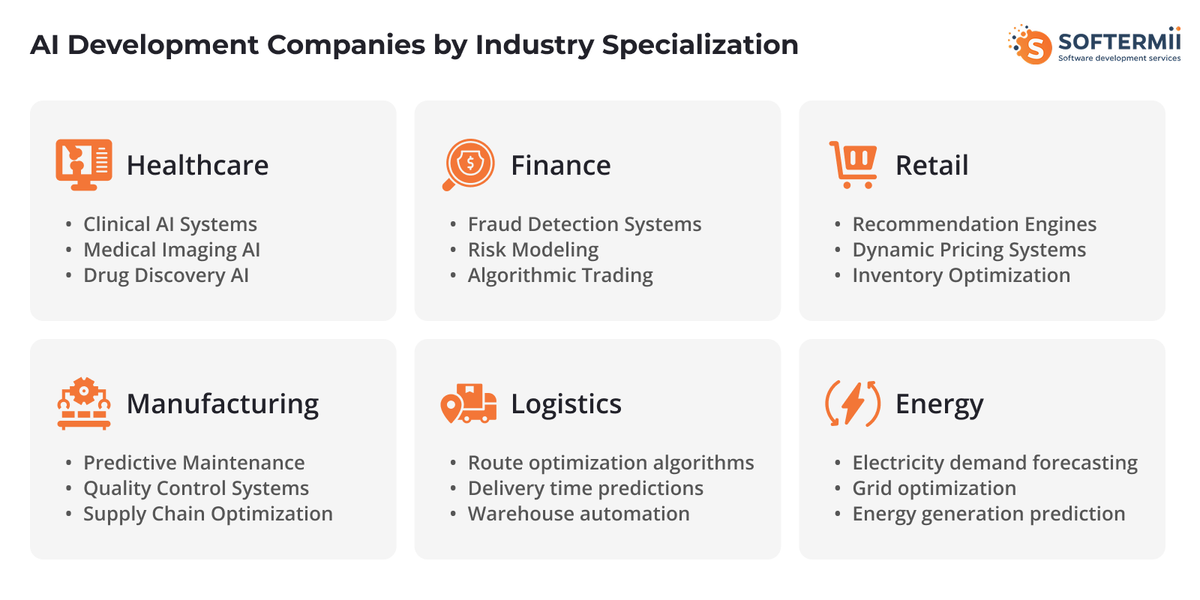
Selecting an AI development company with deep industry expertise significantly increases project success rates. Generic AI knowledge fails when applied to regulated industries, complex operational environments, or domains with specialized data requirements. This section breaks down leading AI solution providers by their industry focus and the types of systems they build.
Healthcare & Life Sciences AI Developers
Healthcare AI requires understanding of clinical workflows, regulatory compliance (HIPAA, FDA, GDPR), medical terminology, and patient safety considerations. The best healthcare AI development companies combine technical AI expertise with healthcare domain knowledge.
Clinical AI Systems
Companies like Softermii and Arterys develop clinical decision support systems that assist healthcare providers with diagnosis and treatment planning. These systems analyze patient data, medical histories, lab results, and imaging to identify patterns and suggest clinical pathways. Implementation requires strict accuracy standards, explainability for medical professionals, and integration with electronic health records (EHR).
Typical projects include sepsis prediction models that alert clinicians to early warning signs, readmission risk scoring that identifies high-risk patients needing additional support, and treatment recommendation engines that suggest evidence-based interventions based on patient characteristics.
Medical Imaging AI
Computer vision applications for radiology, pathology, and diagnostic imaging represent a major focus area. AI engineering companies specializing in medical imaging build models that detect tumors, fractures, retinal diseases, and other conditions from X-rays, CT scans, MRIs, and pathology slides.
These systems use convolutional neural networks trained on massive datasets of labeled medical images. The best implementations don't replace radiologists—they serve as second readers that highlight areas of concern, reducing screening time and catching findings that might otherwise be missed.
Drug Discovery AI
Pharmaceutical and biotech companies work with specialized artificial intelligence development companies to accelerate drug discovery. AI models predict molecular interactions, identify promising drug candidates, optimize molecular structures, and forecast clinical trial outcomes.
Projects include protein folding prediction, compound screening for specific therapeutic targets, and patient stratification for clinical trials. These implementations require deep understanding of biochemistry, pharmacology, and regulatory drug development processes.
Healthcare Operations Optimization
Beyond clinical applications, AI improves healthcare operations through patient scheduling optimization, staffing predictions based on admission forecasts, supply chain management for medical supplies, and revenue cycle optimization.
Leading healthcare AI specialists: Softermii (clinical systems, medical imaging), Arterys (FDA-cleared imaging AI), Tempus (precision medicine), Paige.AI (pathology AI)
Financial Services AI Development Firms
Financial services demand AI development partners who understand risk management, regulatory compliance (SOX, Basel III, MiFID II), real-time processing requirements, and the high cost of errors. Fintech AI developers build systems where accuracy and explainability are non-negotiable.
Fraud Detection Systems
Real-time fraud detection represents one of the most mature AI applications in finance. These systems analyze transaction patterns, user behavior, device fingerprints, and contextual signals to identify suspicious activity before transactions complete.
Softermii and other financial services AI development firms build models using ensemble learning, anomaly detection, and graph neural networks to spot fraud patterns. The challenge lies in minimizing false positives—legitimate transactions incorrectly flagged as fraud frustrate customers and create operational burden.
Advanced implementations include adaptive models that learn from fraud analyst feedback, explainability features showing why transactions were flagged, and integration with case management systems for investigation workflows.
Risk Modeling
Banks and lenders use AI for credit risk assessment, market risk analysis, and operational risk prediction. Machine learning models analyze borrower data, transaction histories, alternative data sources, and macroeconomic indicators to predict default probability, estimate loan losses, and optimize lending decisions.
The best systems provide clear explanations for risk scores—critical for regulatory compliance and adverse action notices. They also monitor for bias in lending decisions across protected demographic groups.
Algorithmic Trading
Hedge funds and trading firms employ specialized AI technology companies to build algorithmic trading systems. These models identify trading opportunities, predict price movements, optimize execution strategies, and manage portfolio risk.
Projects range from high-frequency trading algorithms processing market data in microseconds to longer-term investment strategies using alternative data sources like satellite imagery, social media sentiment, or web traffic patterns.
Regulatory Compliance AI
Financial institutions face overwhelming compliance requirements. AI systems automate compliance monitoring, transaction surveillance for money laundering (AML), sanctions screening, and regulatory reporting.
Natural language processing models analyze communications for compliance violations, extract data from regulatory documents, and monitor policy changes across jurisdictions.
Leading financial AI specialists: Softermii (fraud detection, risk models), Kensho/S&P Global (market intelligence), DataRobot partners (credit risk), Ayasdi (AML compliance)
Retail & E-commerce AI Companies
Retail AI focuses on customer experience, operational efficiency, and revenue optimization. AI development firms in this space understand consumer behavior, inventory dynamics, and omnichannel commerce.
Recommendation Engines
Personalized product recommendations drive significant revenue for e-commerce companies. AI models analyze browsing behavior, purchase history, product attributes, and similar customer patterns to suggest relevant products.
Advanced implementations use deep learning for session-based recommendations, contextual bandits for exploration-exploitation trade-offs, and real-time personalization that adapts to user behavior within single sessions. Softermii has built recommendation systems that increased average order values by 15-25% for retail clients.
Dynamic Pricing Systems
AI-powered pricing engines optimize prices based on demand forecasts, competitor pricing, inventory levels, and customer willingness to pay. These systems balance revenue maximization with inventory turnover and competitive positioning.
Implementation requires careful testing—poorly designed pricing AI can erode margins or create customer backlash. The best systems include business rules that constrain AI decisions and prevent problematic pricing.
Inventory Optimization
Demand forecasting models predict future sales at product and location levels, enabling optimal inventory allocation. These systems analyze historical sales, seasonality, promotions, weather, local events, and market trends.
Advanced implementations optimize across the entire supply chain—from manufacturing and distribution center stocking to individual store allocation. Softermii's inventory optimization projects typically reduce stockouts by 20-30% while cutting excess inventory.
Customer Analytics
Retailers use AI for customer lifetime value prediction, churn prevention, next-best-action recommendations, and customer segmentation. Models identify high-value customers, predict which customers are at risk of churning, and suggest personalized retention strategies.
Computer vision systems analyze in-store behavior, detect out-of-stock conditions, and optimize store layouts based on traffic patterns captured through cameras.
Leading retail AI specialists: Softermii (recommendations, demand forecasting), Trax (computer vision for retail), Blue Yonder (supply chain AI), Dynamic Yield (personalization)
Manufacturing & Supply Chain AI Developers
Manufacturing AI requires understanding of industrial processes, equipment mechanics, supply chain complexity, and operational constraints. AI system integrators in this sector build solutions that withstand harsh production environments.
Predictive Maintenance
AI models predict equipment failures before they occur, reducing unplanned downtime and maintenance costs. Systems analyze sensor data from machinery—temperature, vibration, pressure, acoustic signals—to identify degradation patterns indicating impending failure.
Implementation requires domain expertise to engineer meaningful features from raw sensor data, understand failure modes for specific equipment types, and integrate predictions with maintenance scheduling systems. Successful deployments reduce downtime by 30-50% while optimizing maintenance spending.
Quality Control Systems
Computer vision AI automates visual inspection, detecting product defects faster and more consistently than human inspectors. Systems identify scratches, cracks, misalignments, color variations, and dimensional deviations in manufactured products.
Softermii and specialized manufacturing AI companies build models trained on thousands of defect images. These systems integrate with production lines, triggering rejection of defective items and alerting operators to quality issues requiring intervention.
Supply Chain Optimization
AI optimizes complex supply chain decisions including supplier selection, production scheduling, inventory positioning, and logistics routing. Models balance multiple objectives—cost, lead time, quality, risk—while respecting real-world constraints.
Advanced implementations use reinforcement learning for dynamic decision-making, graph neural networks for supply network analysis, and simulation for scenario planning.
Demand Forecasting
Manufacturing demand forecasts drive production planning, raw material procurement, and workforce scheduling. AI models analyze order history, market trends, customer forecasts, and economic indicators to predict future demand.
The best systems provide uncertainty estimates alongside predictions, enabling planners to make risk-adjusted decisions. They also detect demand shifts early, allowing agile production adjustments.
Leading manufacturing AI specialists: Softermii (predictive maintenance, quality control), Uptake (industrial AI), Sight Machine (manufacturing analytics), C3 AI (enterprise AI for manufacturing)
Ready to discuss your AI project? Schedule a free 30-minute consultation with Softermii's AI architects. Free Consultation No obligation • Quick response
Other Industries
Energy & Utilities
AI development companies serving energy utilities build predictive models for electricity demand forecasting, renewable energy generation prediction, grid optimization, and predictive maintenance for power infrastructure. Smart meter data analysis identifies consumption patterns and detects energy theft.
Transportation & Logistics
Logistics AI solution providers develop route optimization algorithms, delivery time predictions, warehouse automation systems, and fleet management solutions. Last-mile delivery optimization uses reinforcement learning to adapt routes in real-time based on traffic, weather, and new orders.
Real Estate
Real estate AI includes property valuation models, investment opportunity identification, tenant screening systems, and predictive maintenance for property management. Computer vision analyzes property images to extract features affecting valuations.
Telecommunications
Telecom companies use AI for network optimization, customer churn prediction, predictive maintenance of infrastructure, and fraud detection. Natural language processing powers customer service chatbots and analyzes support tickets.
What Top AI Development Companies Actually Build
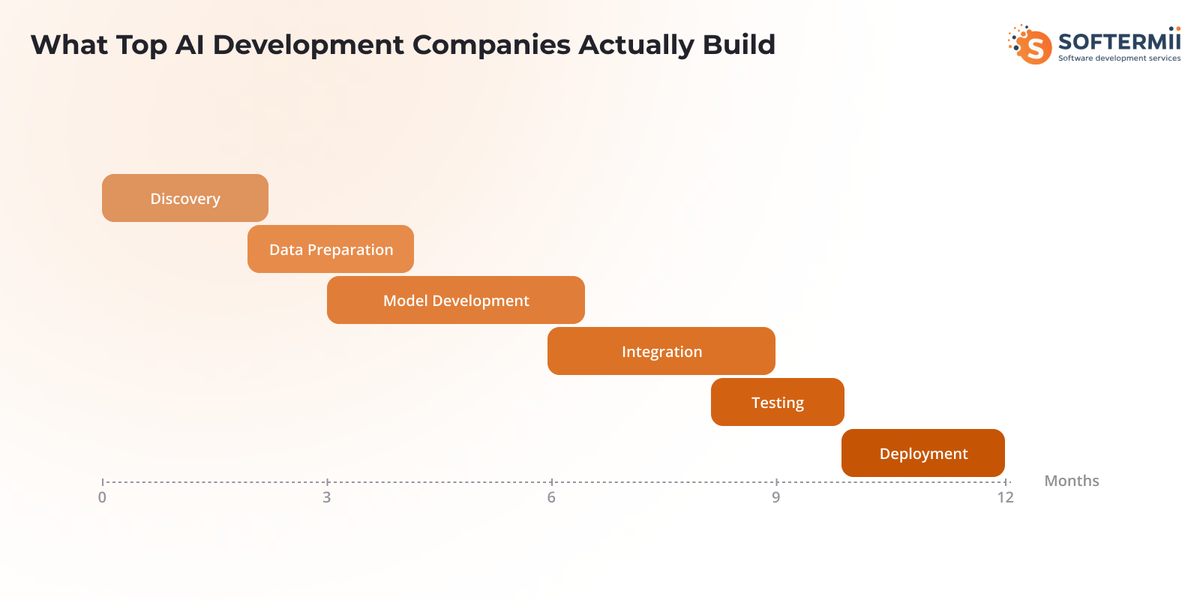
Understanding the specific systems and solutions that AI software development companies create helps set realistic expectations for timelines, complexity, and costs. This section breaks down common AI development projects with typical implementation details.
Custom ML Model Development
What it involves: Building machine learning models tailored to specific business problems and datasets. This includes data exploration, feature engineering, algorithm selection, model training, validation, and optimization.
Typical use cases:
- Classification models that categorize data (spam detection, customer segmentation, quality assessment)
- Regression models that predict numerical values (sales forecasts, pricing optimization, risk scores)
- Clustering models that identify natural groupings in data (customer segments, anomaly detection)
Complexity levels:
- Simple: Binary classification with clean, structured data (2-3 months)
- Moderate: Multi-class prediction with mixed data types and feature engineering (3-6 months)
- Complex: Deep learning models requiring large datasets and specialized architectures (6-12 months)
What clients receive: Trained models, performance reports, feature importance analysis, model documentation, and deployment-ready code. Leading AI development companies like Softermii also provide ongoing model monitoring and retraining processes.
AI System Architecture and Integration
What it involves: Designing complete AI systems that integrate with existing business infrastructure. This includes data pipelines, model serving architecture, API development, monitoring systems, and feedback loops.
Typical components:
- Data ingestion pipelines collecting information from multiple sources
- Feature stores providing consistent data for model training and serving
- Model serving infrastructure handling real-time predictions at scale
- Monitoring dashboards tracking model performance and data drift
- Automated retraining pipelines keeping models current
Integration challenges: Connecting AI systems with legacy databases, enterprise software (ERP, CRM), authentication systems, and existing workflows. Enterprise AI companies excel at navigating complex IT environments.
Timeline: 4-9 months for comprehensive system architecture with production deployment.
Example: A fraud detection system might ingest transaction data from payment processors, enrich it with customer history from CRM systems, score transactions in real-time using ML models, send high-risk cases to investigation queues, and continuously retrain models based on fraud analyst feedback.
Computer Vision Solutions
What it involves: Building systems that analyze visual information from images and videos. Uses convolutional neural networks and specialized architectures for specific vision tasks.
Common applications:
- Object detection: Identifying and locating specific objects in images (manufacturing quality control, inventory tracking, security monitoring)
- Image classification: Categorizing entire images (medical diagnosis, product categorization, content moderation)
- Facial recognition: Identifying individuals or detecting emotions (security, customer analytics, user authentication)
- OCR and document processing: Extracting text from images and documents (invoice processing, form digitization)
- Defect detection: Identifying product flaws in manufacturing (surface scratches, dimensional errors, color variations)
Data requirements: Computer vision models typically need thousands to millions of labeled images. AI development vendors often include data collection and annotation as part of projects.
Complexity and timeline:
- Standard applications: Using pre-trained models with transfer learning (2-4 months)
- Custom applications: Building specialized models for unique use cases (4-8 months)
- Advanced systems: Real-time video analysis or complex multi-stage pipelines (6-12 months)
Example from Softermii: A quality inspection system for a manufacturing client analyzes product images at 10 frames per second, detecting defects with 98% accuracy. The system flagged 2,000+ defective products in the first month that would have reached customers under manual inspection.
Natural Language Processing Systems
What it involves: Building AI that understands, generates, or analyzes human language. Ranges from simple text classification to sophisticated language understanding.
Common applications:
- Text classification: Categorizing documents, emails, or support tickets by topic, sentiment, or urgency
- Named entity recognition: Extracting specific information (names, dates, amounts) from unstructured text
- Sentiment analysis: Determining emotional tone of text for customer feedback, social media monitoring, or brand perception
- Document summarization: Automatically creating concise summaries of long documents
- Question answering: Building systems that respond to natural language questions based on document repositories
- Language translation: Custom translation systems for specialized domains
Typical timeline: 3-8 months depending on language complexity, domain specialization, and integration requirements.
Modern approaches: Many AI consulting companies now build NLP solutions using large language models (GPT, Claude, Llama) with custom fine-tuning, retrieval-augmented generation (RAG), or prompt engineering rather than training models from scratch.
Example: A financial services client engaged Softermii to build a contract analysis system that extracts key terms, identifies risks, and flags non-standard clauses. The system processes contracts in minutes that previously required hours of manual legal review.
Predictive Analytics Platforms
What it involves: Systems that forecast future outcomes based on historical patterns. Uses time series analysis, regression models, and ensemble learning techniques.
Business applications:
- Demand forecasting: Predicting future product demand for inventory and production planning
- Customer churn prediction: Identifying customers likely to cancel or stop purchasing
- Revenue forecasting: Projecting future sales, cash flow, or financial performance
- Risk prediction: Estimating probability of loan defaults, insurance claims, or operational failures
- Lifetime value prediction: Calculating expected long-term value of customers
Implementation components:
- Historical data analysis and pattern identification
- Feature engineering incorporating business knowledge
- Model selection balancing accuracy and interpretability
- Uncertainty quantification providing confidence intervals
- Dashboard interfaces for business users
Timeline: 3-7 months from data assessment through production deployment with business user training.
Value drivers: The best predictive analytics don't just forecast—they enable better decisions. Softermii's implementations typically include scenario analysis tools, what-if modeling, and actionable recommendations alongside predictions.
Recommendation Systems
What it involves: AI that suggests products, content, or actions personalized to individual users. Powers e-commerce, streaming services, content platforms, and marketing automation.
Approaches:
- Collaborative filtering: Recommending based on similar users' behavior
- Content-based filtering: Suggesting items similar to what users previously liked
- Hybrid systems: Combining multiple recommendation strategies
- Deep learning recommendations: Using neural networks for complex pattern recognition
- Context-aware recommendations: Incorporating time, location, device, and session context
Implementation considerations:
- Cold start problem (new users or items with limited data)
- Real-time vs. batch recommendations
- Diversity vs. accuracy trade-offs
- A/B testing infrastructure for continuous optimization
Typical timeline: 3-6 months for initial implementation, ongoing optimization afterward.
Business impact: Well-designed recommendation systems increase conversion rates by 15-30% and boost average order values. Softermii's e-commerce recommendation projects consistently deliver measurable ROI within months of deployment.
AI-Powered Automation
What it involves: Using AI to automate complex tasks that previously required human judgment. Goes beyond simple rule-based automation by handling variability and ambiguity.
Common automation projects:
- Document processing: Extracting data from invoices, receipts, forms, and contracts
- Email routing: Automatically categorizing and routing customer emails to appropriate departments
- Data entry automation: Populating systems from documents, emails, or forms
- Report generation: Creating business reports and summaries from raw data
- Workflow orchestration: Making decisions about process routing based on content analysis
Technology combination: Most automation projects combine multiple AI capabilities—OCR for text extraction, NLP for understanding, classification for routing, and traditional logic for workflow management.
Timeline: 2-6 months depending on process complexity and system integration requirements.
ROI focus: Automation projects deliver clear cost savings. AI development companies typically measure success in hours saved, error reduction, and processing speed improvements.
Conversational AI and Chatbots
What it involves: Building AI systems that engage in natural language conversations with users. Ranges from simple FAQ bots to sophisticated virtual assistants.
Capability levels:
- Rule-based chatbots: Following predetermined conversation flows (1-2 months)
- Intent-based chatbots: Understanding user intent and responding appropriately (2-4 months)
- Context-aware assistants: Maintaining conversation context and handling complex dialogs (3-6 months)
- Task-completion bots: Actually executing actions (booking appointments, processing orders) alongside conversation (4-8 months)
Implementation components:
- Natural language understanding to interpret user messages
- Dialog management to control conversation flow
- Response generation to create appropriate replies
- Integration with backend systems to retrieve information or complete tasks
- Analytics tracking conversation success and identifying improvement areas
Success metrics: Good conversational AI handles 60-80% of inquiries without human intervention, maintains high user satisfaction, and gracefully transfers complex cases to human agents.
Example from Softermii: A customer service chatbot for a telecom company now handles 70% of common inquiries (billing questions, plan changes, technical troubleshooting), reducing call center volume and wait times while improving customer satisfaction scores.
Get a Custom Quote for Your AI Project Tell us about your project and receive: • Estimated timeline and cost • Recommended technical approach • Next steps for your project Request Custom Quote
Implementation Timelines Summary
| Project Type | Simple Implementation | Moderate Complexity | Advanced System |
|---|---|---|---|
| Custom ML Models | 2-3 months | 3-6 months | 6-12 months |
| Computer Vision | 2-4 months | 4-8 months | 6-12 months |
| NLP Systems | 3-5 months | 5-8 months | 8-14 months |
| Predictive Analytics | 3-5 months | 5-7 months | 7-12 months |
| Recommendation Engines | 3-4 months | 4-6 months | 6-10 months |
| Automation Systems | 2-4 months | 4-6 months | 6-9 months |
| Conversational AI | 2-3 months | 3-6 months | 6-10 months |
| Complete AI Platforms | 6-9 months | 9-15 months | 15-24 months |
Timeline factors: Complexity depends on data quality and availability, number of system integrations, custom vs. standard requirements, regulatory compliance needs, and internal stakeholder alignment. Organizations with clean data and clear requirements move faster than those still defining problems or fixing data issues.
Comparing AI Development Companies: Evaluation Framework
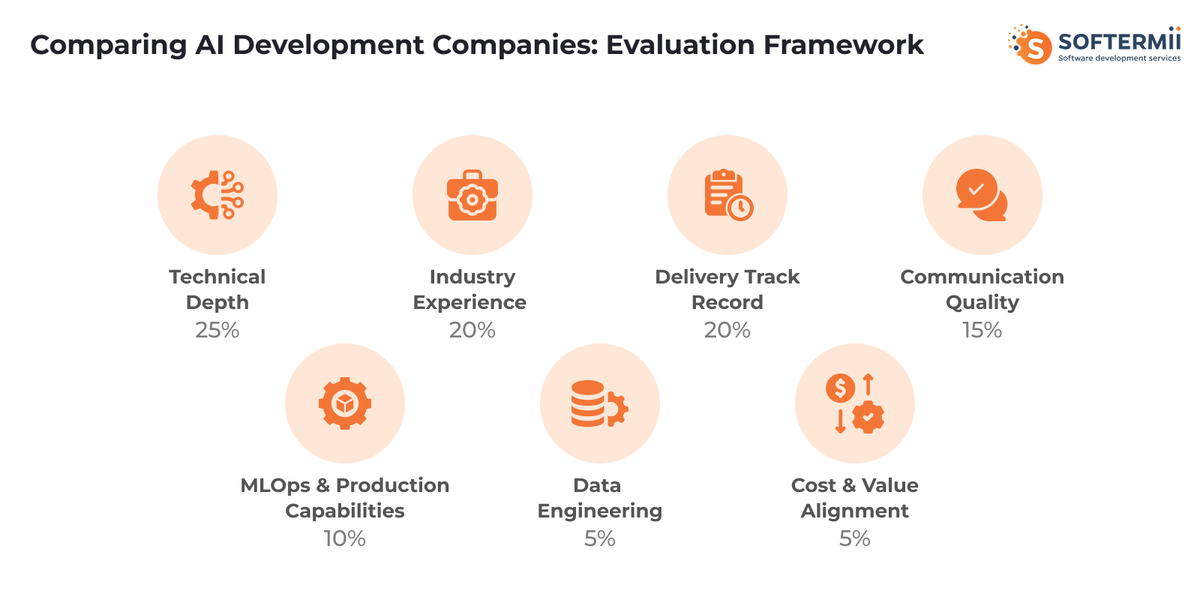
Selecting the right AI development partner requires systematic comparison across technical, business, and operational dimensions. This framework provides a structured approach for evaluating AI consulting and development firms based on criteria that actually predict project success.
Comprehensive Comparison Matrix
| Evaluation Category | Weight | What to Score (1-5) | How to Assess | Red Flags |
|---|---|---|---|---|
| Technical Depth | 25% | ML engineering expertise, research capabilities, technology stack currency, architectural skills | Review team backgrounds, ask technical questions, examine code samples, check publications | Vague technical explanations, outdated frameworks, no senior engineers on sales calls |
| Industry Experience | 20% | Domain knowledge depth, relevant case studies, regulatory understanding, workflow familiarity | Request case studies in your sector, verify client references, assess domain vocabulary | Generic examples, no industry-specific insights, unfamiliarity with your challenges |
| Delivery Track Record | 20% | On-time delivery, budget adherence, production deployments, client satisfaction | Check references, ask about project challenges, verify production systems, review testimonials | No production deployments, vague project outcomes, unwilling to provide references |
| Communication Quality | 15% | Transparency, responsiveness, technical explanation ability, proactive updates | Assess during sales process, request project communication samples, talk to past clients | Slow responses, overpromising, inability to explain trade-offs, avoiding difficult questions |
| MLOps & Production Capabilities | 10% | Deployment experience, monitoring practices, maintenance processes, scalability expertise | Ask about deployment approaches, request infrastructure examples, verify monitoring tools | Weak deployment planning, no monitoring strategy, unclear maintenance model |
| Data Engineering | 5% | Pipeline development, data quality management, ETL expertise, feature engineering | Discuss data preparation approaches, assess data team composition, review pipeline examples | Underestimating data work, no data engineering resources, weak data quality practices |
| Cost & Value Alignment | 5% | Pricing transparency, value demonstration, flexible engagement models, ROI focus | Compare pricing, assess value justification, evaluate flexibility, discuss success metrics | Hidden costs, rigid contracts, no ROI discussion, pricing without scope understanding |
Technical Capability Deep Dive
Scoring Technical Depth (1-5 scale):
Score 5 - Exceptional: Team includes published researchers, contributes to open-source AI projects, demonstrates deep learning expertise across multiple domains, shows innovative problem-solving in case studies. Example: Softermii's team has built custom neural architectures for specialized computer vision tasks and published findings on model optimization techniques.
Score 4 - Strong: Senior ML engineers with 5+ years experience, proven track record with modern frameworks (TensorFlow, PyTorch), successful production deployments, stays current with AI advances.
Score 3 - Adequate: Competent implementation of standard ML techniques, uses established frameworks effectively, delivers working solutions but limited innovation or advanced capabilities.
Score 2 - Weak: Junior team, relies heavily on pre-built solutions, struggles with custom requirements, limited understanding of advanced techniques.
Score 1 - Inadequate: No genuine ML expertise, outsources technical work, cannot explain model decisions, uses "AI" label for basic automation.
Verification methods:
- Request technical architecture documents from past projects
- Ask them to explain trade-offs between different modeling approaches for your use case
- Review team member profiles and experience
- Request code samples or GitHub repositories (if available)
- Discuss recent AI research papers and their applicability
Portfolio Quality Evaluation
When examining case studies and past projects from AI development firms, assess these dimensions:
Project Complexity: Do examples show sophisticated AI implementations or basic integrations? Look for custom model development, handling of challenging data conditions, and solving genuinely difficult problems rather than implementing standard solutions.
Measurable Outcomes: Strong AI solution providers document quantitative results: accuracy improvements, cost reductions, time savings, revenue increases. Vague claims like "improved efficiency" without numbers indicate weak results tracking.
Production Evidence: Anyone can build a prototype. The best AI development companies show production systems handling real workloads, scaled to actual user volumes, and operating reliably over time.
Problem Similarity: Case studies resembling your project indicate relevant experience. A company with strong retail AI experience might struggle with manufacturing applications despite technical competence.
Client Types: Companies serving similar-sized organizations understand your constraints. Enterprise-focused firms might not suit startup budgets or timelines. Boutique firms might lack enterprise compliance capabilities.
Client Testimonial Assessment
Not all testimonials carry equal weight. Evaluate references systematically:
What to ask references:
- "What challenges emerged during the project, and how did the vendor handle them?"
- "How accurate were initial timeline and budget estimates?"
- "Is the AI system still running in production? What maintenance has been required?"
- "How would you rate their technical expertise? Communication? Problem-solving?"
- "What would you do differently if starting over?"
- "Would you hire them again? Why or why not?"
Strong indicators:
- References discuss specific technical capabilities and business outcomes
- Honest discussion of challenges and how they were resolved
- Systems remain in production months or years after deployment
- References would rehire for future projects
Warning signs:
- Generic praise without specific examples
- References are only from pilot projects, not production deployments
- Reluctance to discuss challenges or surprises
- AI system no longer in use or never reached production
Delivery Methodology Comparison
Different AI development vendors use various project approaches. Understanding these helps set appropriate expectations:
| Methodology | Best For | Typical Timeline | Flexibility | Client Involvement | Risk Level |
|---|---|---|---|---|---|
| Agile/Iterative | Exploratory AI projects, evolving requirements, learning-focused initiatives | Longer overall but continuous delivery | High - adapts to findings | High - frequent feedback cycles | Lower - validates approach incrementally |
| Waterfall | Well-defined requirements, regulatory projects, fixed scope deliverables | Shorter if scope is accurate | Low - changes are expensive | Lower - primarily at phase gates | Higher - late validation of approach |
| Hybrid | Most AI projects - combines structure with flexibility | Medium - balances planning and adaptation | Medium - structured flexibility | Medium - regular touchpoints | Medium - managed through staged validation |
| Discovery + Implementation | Uncertain feasibility, new AI applications, complex problems | Longer - includes exploration phase | High in discovery, lower in implementation | Very high in discovery phase | Lower - validates feasibility before commitment |
Softermii's approach: Uses hybrid methodology with initial discovery sprint (2-4 weeks) to validate data quality and feasibility, followed by iterative development with 2-week sprints and continuous client collaboration. This balances structure with the flexibility AI projects require.
Pricing Structure Comparison Framework
| Pricing Model | Transparency | Budget Predictability | Flexibility | Risk Distribution | Best For |
|---|---|---|---|---|---|
| Fixed Price | High - clear total cost | High - known upfront | Low - change orders expensive | Vendor bears scope risk | Well-defined projects, limited unknowns |
| Time & Materials | Medium - hourly rates clear but total unknown | Low - final cost uncertain | High - easy to adjust scope | Client bears scope risk | Exploratory projects, evolving requirements |
| Capped Time & Materials | High - maximum cost defined | Medium - ceiling provides protection | Medium - flexibility within cap | Shared risk | Projects with some uncertainty |
| Milestone-Based | High - cost per milestone clear | High - phased payments | Medium - can pause between phases | Shared - validates progress incrementally | Longer projects, staged implementations |
| Retainer / Dedicated Team | High - monthly cost known | High - predictable ongoing cost | High - easy to redirect focus | Shared - ongoing partnership | Extended engagements, continuous development |
Hidden costs to clarify upfront:
- Infrastructure and cloud computing expenses
- Third-party API costs (for services like Google Vision, AWS services)
- Data labeling and annotation services
- Post-deployment support and maintenance
- Model retraining and optimization
- Training for internal teams
- Integration with additional systems beyond original scope
Value vs. Cost Assessment
The cheapest AI development company rarely delivers the best value. Assess total cost of ownership:
Direct costs: Development fees, infrastructure, third-party services
Indirect costs: Internal team time spent managing vendor, delays due to poor communication or technical issues, rework from incorrect approaches, opportunity cost of slower time-to-value
Risk costs: Probability of project failure multiplied by failure cost, security or compliance violations, technical debt from poor implementation requiring future remediation
Value factors: Time to market advantage, competitive differentiation, operational efficiency gains, revenue increases from new capabilities, learning and capability building for internal teams
Example calculation: Company A quotes $400K with 6-month timeline and strong track record. Company B quotes $250K with 9-month timeline and limited experience. Company A might deliver better value if faster time-to-market is worth $150K+ or if Company B's higher failure risk outweighs cost savings.
Scoring and Decision Framework
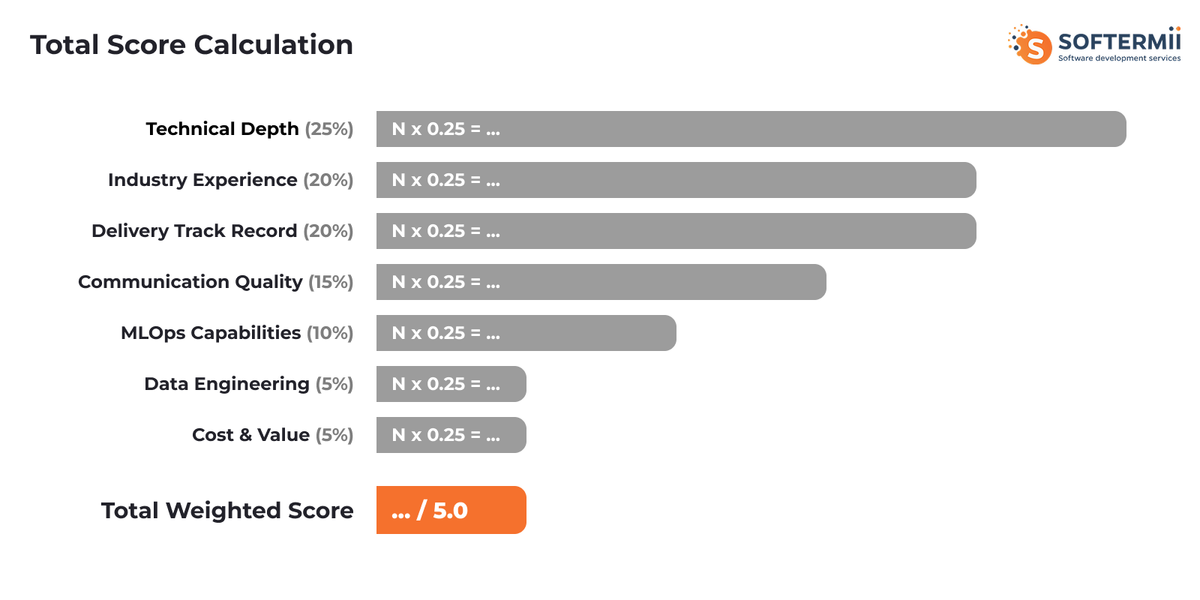
Aggregate scores using the weighted framework:
Total Score Calculation:
Decision guidance:
- 4.0-5.0: Excellent fit - proceed with confidence
- 3.5-3.9: Strong candidate - verify specific concerns before proceeding
- 3.0-3.4: Adequate but not ideal - consider if better options exist
- Below 3.0: Significant gaps - likely not the right partner
This framework works as a reusable tool across multiple vendor evaluations, enabling objective comparison rather than relying on sales presentations or subjective impressions.
Cost Structure: What to Expect from Top AI Development Companies
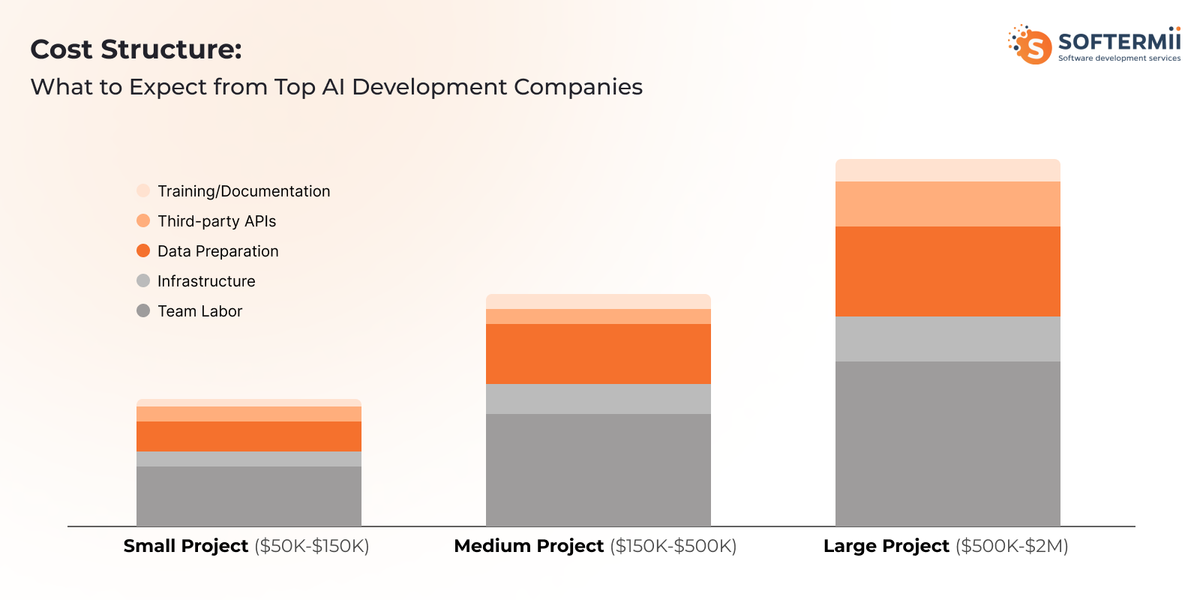
Understanding AI development costs helps organizations budget appropriately and evaluate vendor proposals realistically. Top AI development companies structure pricing in several ways, each with different implications for budget predictability, flexibility, and risk distribution.
Typical Pricing Models
Hourly Rate Structure
Most AI software development firms charge hourly rates that vary by role and expertise level:
| Role | Typical Hourly Range | When They're Involved |
|---|---|---|
| AI/ML Engineer (Senior) | $150-$300 | Model development, architecture design, algorithm selection, optimization |
| AI/ML Engineer (Mid-level) | $100-$200 | Model implementation, feature engineering, testing, deployment support |
| Data Scientist | $120-$250 | Data analysis, statistical modeling, experimentation, validation |
| Data Engineer | $100-$180 | Data pipeline development, ETL processes, data quality management |
| MLOps Engineer | $120-$220 | Deployment infrastructure, monitoring, CI/CD for ML, production optimization |
| AI Architect | $180-$350 | System design, technology selection, architectural decisions, technical leadership |
| Project Manager | $80-$150 | Coordination, stakeholder communication, timeline management, risk mitigation |
| Business Analyst | $70-$130 | Requirements gathering, process mapping, success metrics definition |
Geographic variations: Rates vary significantly by location. U.S.-based teams typically command highest rates ($150-$350/hour for senior roles). European teams range $100-$250/hour. Eastern European firms like Softermii offer $80-$180/hour while maintaining strong technical capabilities. Asian teams range $50-$150/hour.
Project-Based Pricing
Fixed-price projects provide budget certainty but require well-defined scope. AI development companies typically structure project pricing as:
Small AI Projects: $50,000-$150,000
- Simple machine learning models with clean data
- Basic chatbot implementations
- Proof-of-concept developments
- Single-feature AI additions to existing systems
- Timeline: 2-4 months
Medium AI Projects: $150,000-$500,000
- Custom recommendation engines
- Computer vision applications for specific use cases
- NLP systems with moderate complexity
- Predictive analytics platforms
- End-to-end AI system with limited integrations
- Timeline: 4-8 months
Large AI Projects: $500,000-$2,000,000
- Enterprise-scale AI platforms
- Complex multi-model systems
- Advanced computer vision with custom architectures
- Comprehensive AI solutions with extensive integration
- Industry-specific AI systems (healthcare diagnostics, financial trading)
- Timeline: 8-18 months
Enterprise AI Transformations: $2,000,000-$10,000,000+
- Organization-wide AI implementations
- Multiple integrated AI systems
- Custom AI infrastructure development
- Extensive change management and training
- Long-term strategic partnerships
- Timeline: 12-36 months
Retainer and Dedicated Team Models
For ongoing AI development, AI consulting companies offer dedicated team arrangements:
Dedicated AI Team Monthly Costs:
- Small team (2-3 people): $25,000-$50,000/month
- Medium team (4-6 people): $50,000-$100,000/month
- Large team (7-10 people): $100,000-$200,000/month
This model suits organizations building AI products, requiring continuous AI development, or maintaining and optimizing existing AI systems. Softermii's dedicated teams include balanced combinations of ML engineers, data scientists, and supporting roles tailored to client needs.
Cost Drivers: What Makes AI Projects More Expensive
Data Quality and Availability
Poor data quality dramatically increases costs. If your data requires extensive cleaning, labeling, or enrichment, expect 30-50% higher costs and longer timelines. Projects requiring new data collection or third-party data acquisition add significant expenses.
Example: A computer vision project with 10,000 pre-labeled, high-quality images might cost $150K. The same project requiring manual labeling of 10,000 images adds $50K-$100K in data preparation costs alone.
Model Complexity
Simple models (logistic regression, decision trees, standard neural networks) cost less than advanced architectures. Deep learning models requiring GPUs for training, custom neural architectures, or cutting-edge techniques increase development time and computational costs.
Deployment Scale and Performance Requirements
Systems handling 100 requests per day cost significantly less than those processing 10,000 requests per second. Real-time inference requirements, low-latency demands, and high-availability needs all increase infrastructure complexity and costs.
Integration Complexity
Standalone AI models are simpler than systems integrating with multiple enterprise applications. Each integration point adds development time, testing requirements, and potential complications.
Example: An AI model with a simple REST API might require 2-3 weeks of deployment work. Integrating the same model with SAP, Salesforce, and a custom legacy system could require 2-3 months of integration effort.
Regulatory Compliance
Projects in regulated industries (healthcare, finance, government) require additional work for compliance, audit trails, explainability, and documentation. HIPAA, GDPR, SOC 2, and industry-specific regulations add 20-40% to project costs.
Custom vs. Standard Solutions
Using pre-trained models with transfer learning costs less than building custom models from scratch. Leveraging existing AI platform companies' APIs (Google Vision, AWS Rekognition) reduces costs but limits customization.
Ongoing Maintenance Requirements
AI systems require continuous monitoring and periodic retraining. Budget 15-25% of initial development costs annually for maintenance, monitoring, and optimization.
Hidden Costs to Watch For
Infrastructure and Compute Costs
Cloud computing for model training and inference can be substantial:
- Training costs: $500-$10,000+ per training run for large models
- Inference costs: $100-$5,000+ monthly depending on traffic volume
- Storage costs: $50-$1,000+ monthly for training data and model storage
- GPU costs: $1-$5 per hour for training infrastructure
Some AI development vendors include estimated infrastructure costs in proposals; others bill separately. Clarify this upfront.
Third-Party Services and APIs
Many AI implementations use commercial APIs:
- Image recognition APIs: $1-$5 per 1,000 images
- NLP APIs: $0.50-$2 per 1,000 text units
- Speech recognition: $0.006-$0.024 per 15 seconds
- Data enrichment services: Varies widely by provider
Data Labeling and Annotation
If your project requires labeled training data:
- Simple labeling (image classification): $0.01-$0.10 per image
- Complex labeling (object detection, segmentation): $0.50-$5.00 per image
- Specialized labeling (medical imaging, legal documents): $5-$50+ per item
Training and Documentation
Budget for end-user training, technical documentation, and knowledge transfer to internal teams. This typically adds 5-10% to project costs but proves essential for successful adoption.
Change Requests and Scope Creep
AI projects often reveal new requirements during development. Fixed-price contracts charge premium rates for changes (often 150-200% of standard rates). Time-and-materials contracts handle changes more gracefully but total costs become less predictable.
Cost Comparison by Project Type
| Project Type | Low End | Typical Range | High End | Key Cost Drivers |
|---|---|---|---|---|
| Simple Classification Model | $50K | $75K-$150K | $250K | Data quality, feature count, deployment complexity |
| Computer Vision System | $100K | $150K-$400K | $1M+ | Image volume, custom architecture needs, real-time requirements |
| NLP/Text Analytics | $80K | $120K-$350K | $800K | Language complexity, domain specificity, custom training requirements |
| Recommendation Engine | $100K | $150K-$400K | $1M+ | User scale, real-time needs, cold-start handling, personalization depth |
| Predictive Analytics Platform | $120K | $200K-$500K | $1.5M | Data sources, forecast complexity, integration requirements, UI sophistication |
| Conversational AI/Chatbot | $60K | $100K-$300K | $800K | Intent complexity, integration depth, multi-channel support, task completion capabilities |
| Fraud Detection System | $150K | $300K-$700K | $2M+ | Transaction volume, real-time requirements, false positive minimization, compliance |
| AI-Powered Automation | $80K | $150K-$400K | $1M+ | Process complexity, exception handling, system integrations, workflow variations |
ROI Considerations for Vendor Selection
Time-to-Value Analysis
Faster implementations deliver business value sooner. A vendor charging 20% more but delivering 30% faster might provide better ROI through earlier revenue generation or cost savings.
Calculation example:
- Vendor A: $400K, 8-month timeline
- Vendor B: $320K, 12-month timeline
- Expected monthly value from AI system: $75K
Vendor A delivers value 4 months earlier = $300K additional value, making total value proposition $700K vs. $480K despite higher upfront cost.
Quality and Accuracy Impact
A fraud detection system with 95% accuracy vs. 85% accuracy might catch 50 additional fraudulent transactions monthly. At $5,000 average fraud loss, that's $250K annually—justifying higher development costs for better accuracy.
Maintenance Cost Differences
Well-architected systems with proper MLOps cost less to maintain long-term. Cheap initial development with poor practices creates technical debt requiring expensive remediation.
Example from Softermii: A client's previous AI vendor built a predictive model for $180K but provided no monitoring or retraining processes. Model accuracy degraded from 82% to 61% over 18 months. Softermii's rebuild cost $280K but included automated monitoring and retraining, maintaining 85%+ accuracy with minimal ongoing cost.
Internal Resource Requirements
Less expensive vendors often require more client involvement, consuming internal technical resources. More expensive vendors with comprehensive services reduce internal burden. Calculate total cost including internal team time.
Pricing Negotiation Strategies
Phase the Project
Start with discovery or proof-of-concept phase ($25K-$75K) before committing to full implementation. This validates approach, builds trust, and provides basis for accurate full-project estimates.
Define Success Metrics Clearly
Performance-based pricing ties payments to outcomes. Some AI development firms accept reduced base fees with bonuses for exceeding accuracy targets, meeting timeline milestones, or achieving business KPIs.
Plan for Iteration
AI projects rarely succeed perfectly on first attempt. Budget 15-20% contingency for experimentation, optimization, and addressing unexpected challenges.
Consider Long-Term Partnership
Vendors often discount multi-phase projects or long-term engagements. If you anticipate ongoing AI needs, discuss volume discounts or retainer arrangements.
Value Transparency Over Lowest Price
Detailed proposals with clear scope, assumptions, risks, and exclusions enable better decision-making than vague low-ball estimates. The cheapest proposal often becomes most expensive through change orders and scope disputes.
Budget Planning Framework
Initial Planning Allocation:
- Requirements and discovery: 10-15% of budget
- Data preparation and engineering: 15-25% of budget
- Model development and training: 30-40% of budget
- Integration and deployment: 15-25% of budget
- Testing and optimization: 10-15% of budget
- Documentation and training: 5-10% of budget
Ongoing Annual Costs (Post-Launch):
- Infrastructure and hosting: 10-20% of development cost
- Monitoring and maintenance: 10-15% of development cost
- Model retraining and optimization: 5-10% of development cost
- Feature enhancements: Variable based on roadmap
Total 3-Year Cost of Ownership: Typically 140-180% of initial development cost when including infrastructure, maintenance, and enhancements.
Red Flags: When AI Development Companies Aren't What They Claim
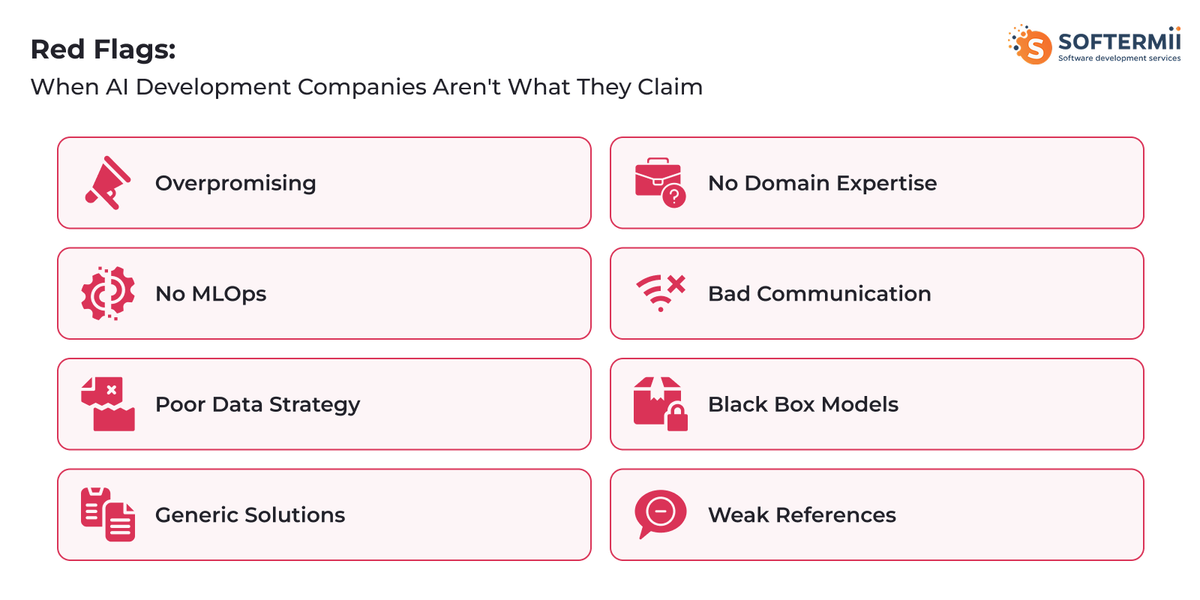
Not every company advertising AI capabilities can deliver production-ready systems. Recognizing warning signs early saves time, money, and project failures. Watch for these red flags when evaluating AI development companies.
Overpromising on Timelines and Results
Warning signs:
- Guaranteeing specific accuracy metrics (95%+ accuracy) before seeing your data
- Promising unrealistic timelines ("we'll have your AI system in production in 4 weeks")
- Claiming AI will solve problems it fundamentally cannot address
- Using phrases like "100% automated" or "eliminates all manual work"
Reality check: Legitimate AI development partners acknowledge uncertainty in AI projects. They discuss potential challenges, explain what makes projects complex, and provide timeline ranges rather than absolute commitments. Softermii and other reputable firms conduct discovery phases specifically to provide realistic estimates after understanding data quality and requirements.
Lack of MLOps and Production Deployment Capability
Warning signs:
- No discussion of model monitoring or performance tracking
- Unclear answers about how models get updated or retrained
- Portfolio shows only prototypes, never production systems
- No mention of deployment infrastructure, scaling, or maintenance
Why it matters: Building models in notebooks differs fundamentally from production deployment. AI engineering companies without MLOps expertise deliver systems that degrade over time, fail under load, or never successfully transition from development to production.
Missing Data Strategy and Expertise
Warning signs:
- Minimal questions about your data during initial conversations
- No data assessment or discovery phase proposed
- Assuming your data is clean and ready for modeling
- No data engineers on the team, only ML engineers
- Dismissing data quality concerns
Reality: Data preparation consumes 60-80% of AI project effort. Companies that underestimate this work deliver late, over-budget projects built on poor-quality data. Strong AI solution providers obsess over data quality from day one.
Generic AI Solutions Without Customization
Warning signs:
- "One-size-fits-all" AI products requiring minimal customization
- Heavy reliance on pre-built models without custom development
- Resistance to tailoring solutions to your specific needs
- Sales pitch focuses on their product rather than your problem
When it matters: Some problems suit standard solutions. But if you need custom AI development, companies pushing generic products won't deliver the specialized capabilities you require.
No Domain Expertise in Your Industry
Warning signs:
- No case studies or references from your industry
- Unfamiliarity with industry-specific terminology
- No questions about regulatory requirements
- Generic approach ignoring industry-specific challenges
Impact: Healthcare AI requires understanding of clinical workflows and HIPAA. Financial AI needs risk management knowledge and regulatory compliance expertise. Artificial intelligence development companies without domain knowledge build technically sound systems that fail business requirements.
Poor Communication and Transparency
Warning signs:
- Vague or jargon-heavy explanations that don't answer questions
- Reluctance to discuss challenges, limitations, or risks
- Slow response times during sales process
- Inability to explain technical approaches in business terms
- Defensive reactions to probing questions
Why it matters: Communication problems during sales conversations amplify during projects. If vendors can't clearly explain their approach before engagement, expect confusion and misalignment during development.
Inability to Explain Model Decisions
Warning signs:
- No discussion of model explainability or interpretability
- Claims that "AI is a black box" without offering transparency solutions
- No mention of feature importance, decision factors, or audit trails
- Dismissing explainability concerns as unimportant
Critical for: Regulated industries, high-stakes decisions, and applications requiring user trust demand explainable AI. Companies ignoring this create compliance risks and systems users won't trust.
Weak or Missing References
Warning signs:
- Unwilling to provide client references
- References are only from pilot projects, not production deployments
- Case studies lack measurable outcomes or specifics
- No verifiable production systems in portfolio
- References praise the relationship but can't articulate business value
Verification approach: Strong AI development vendors readily connect prospects with satisfied clients running production systems. Ask references directly: "Is the AI system still running? What results has it delivered? Would you hire them again?"
Pricing That Seems Too Good to Be True
Warning signs:
- Quotes significantly below market rates for the project scope
- No detailed breakdown of costs and assumptions
- Hidden costs emerge after contract signing
- Aggressive discounting without a clear justification
Reality: Quality AI development costs real money. Unusually low pricing often indicates offshore teams with communication challenges, junior developers lacking expertise, or incomplete understanding of project complexity leading to change orders later.
No Discussion of Risks or Limitations
Warning signs:
- Entirely positive pitch with no acknowledgment of challenges
- No discussion of what could go wrong
- Glossing over data requirements, timeline risks, or technical complexity
- Defensive reaction to questions about failure scenarios
Professional approach: Mature AI development companies openly discuss risks, explain mitigation strategies, and help clients understand where uncertainty exists. This honesty builds trust and sets realistic expectations.
Trust Your Instincts
If something feels off during evaluation—overly aggressive sales tactics, inconsistent information, pressure to sign quickly, reluctance to answer questions—take it seriously. The best AI development partnerships start with honest, transparent conversations that acknowledge both opportunities and challenges.
How to Choose the Right AI Development Company for Your Needs
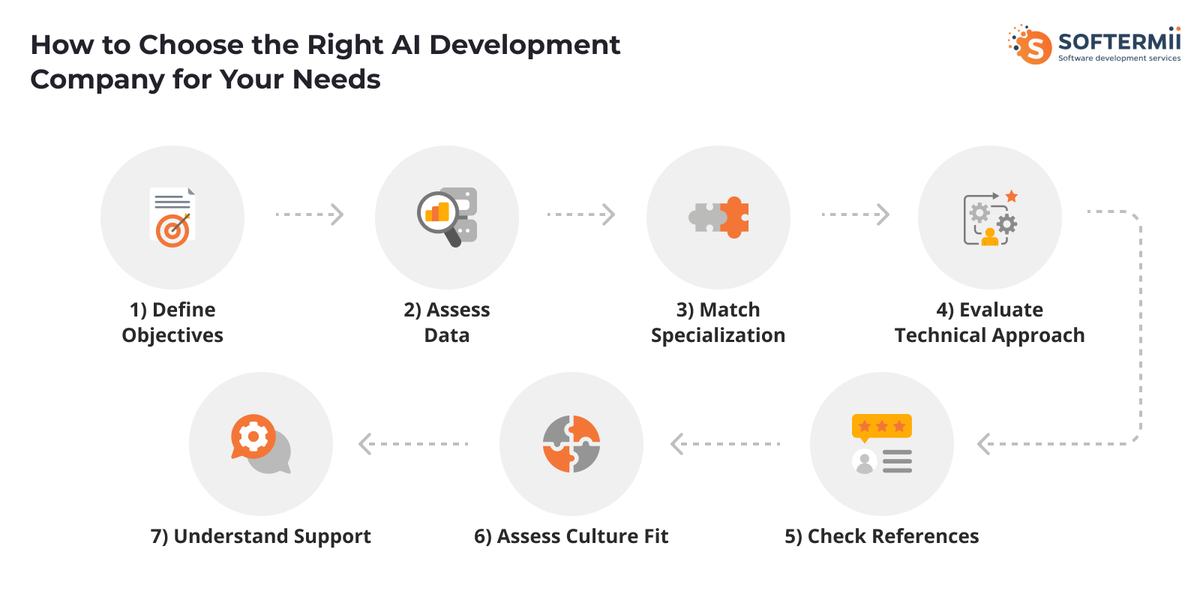
Selecting the right AI development company requires matching vendor capabilities to your specific requirements. Follow this streamlined framework.
Steps
Define Your AI Objectives Clearly
Before evaluating vendors, clarify what you're trying to achieve:
- Specific outcomes: What business problem are you solving? What does success look like quantitatively?
- Expected value: What's the business impact? (cost savings, revenue increase, efficiency gains)
- Constraints: Timeline, budget, compliance requirements, integration needs
Clear objectives help AI consulting companies provide accurate proposals and enable meaningful vendor comparison.
Assess Your Data Readiness
AI quality depends on data quality. Evaluate honestly:
- Availability: Do you have sufficient historical data?
- Quality: Is data clean and consistent, or does it need significant preparation?
- Access: Can you extract data easily? Any privacy restrictions?
- Labeling: Is data already labeled for supervised learning?
Share this assessment with vendors. Strong AI development firms adjust approaches based on data reality.
Match Company Specialization to Your Need
Align vendor strengths with requirements:
- Complex custom systems: Full-stack development companies
- Cutting-edge techniques: Specialized ML consultancies
- Enterprise implementations: Vendors experienced with compliance and enterprise integration
- Industry-specific needs: Companies with domain expertise (healthcare, finance, manufacturing)
- Budget-conscious projects: Boutique studios or firms like Softermii offering flexible engagement models
Evaluate Technical Approach
During vendor discussions, assess their methodology:
Ask specific questions:
- How will you handle our data quality issues?
- What modeling approaches would you consider and why?
- How do you ensure models work reliably in production?
- What happens when model performance degrades?
Red flags: Vague answers, one-size-fits-all solutions, no discussion of challenges or alternatives.
Good signs: Thoughtful trade-off discussions, multiple approach options, honest assessment of difficulties, questions about your specific situation.
Check References and Case Studies
Verify capabilities through past performance:
Request relevant examples: Case studies from your industry or similar use cases.
Talk to references directly: Ask about challenges faced, communication quality, production success, and whether they'd hire again.
Verify production deployments: Ensure examples are running systems, not just prototypes or pilots.
Softermii and reputable AI solution providers readily provide references with measurable outcomes from production systems.
Assess Cultural and Communication Fit
Technical skills matter, but partnership quality determines success:
Evaluate during sales process:
- Are responses timely and thorough?
- Do they ask insightful questions about your business?
- Can they explain technical concepts clearly?
- Do they acknowledge uncertainty and risks honestly?
Consider working style: Do you need hands-on collaboration or prefer minimal involvement? Match vendor engagement style to your preferences.
Geographic and timezone alignment: For projects requiring frequent communication, significant timezone differences can create friction.
Understand Support and Maintenance
AI systems require ongoing attention after deployment:
Clarify upfront:
- What monitoring and alerting comes with deployment?
- How are model updates and retraining handled?
- What's included in base pricing vs. paid support?
- What are response times for production issues?
- How long is support commitment?
Budget 15-25% of development costs annually for maintenance. Leading AI development companies build this into project planning rather than treating it as afterthought.
Decision Framework
Evaluate finalists across key dimensions:
- Technical capability for your specific AI needs
- Industry experience and relevant case studies
- Communication quality and cultural fit
- Pricing transparency and value alignment
- Production track record with working systems
- Support approach for post-deployment success
Choose the vendor scoring highest across these factors rather than optimizing for single dimension like lowest price.
Making the Final Decision
Start with limited engagement when possible:
Discovery phase: 2-4 week paid discovery to validate approach and build confidence before full commitment.
Proof of concept: Small pilot project demonstrating capabilities on your actual data.
Phased approach: Break larger projects into stages with decision points between phases.
This reduces risk while building working relationship with your chosen AI development partner.
Alternatives to Hiring AI Development Companies
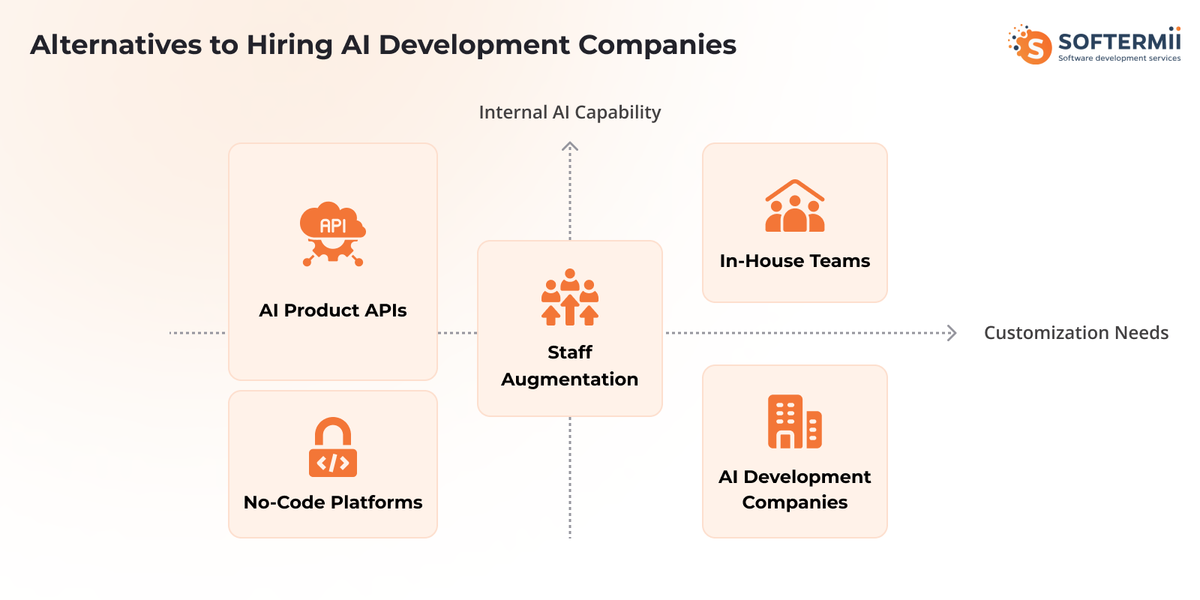
Hiring AI development companies isn't the only path to AI implementation. Consider these alternatives based on your capabilities, timeline, and strategic goals.
| Approach | Best For | Pros | Cons | Typical Cost | Timeline |
|---|---|---|---|---|---|
| Building In-House AI Teams | Organizations with long-term AI strategies, sufficient budget, ability to attract talent | Complete control, retained knowledge, continuous capability, proprietary IP | Expensive, slow to build, recruitment challenges, retention risks | $500K-$1M+ annually for 3-5 person team | 6-12 months to recruit and ramp up |
| No-Code/Low-Code AI Platforms | Standard use cases, limited technical resources, rapid deployment needs | Fast implementation, lower costs, minimal expertise required, vendor support | Limited customization, generic solutions, subscription costs, vendor lock-in | $10K-$100K annually plus implementation time | 1-3 months to implement |
| AI Product APIs | Common use cases matching existing products (translation, image recognition, speech) | Immediate availability, proven performance, minimal development, pay-as-you-go | No customization, data privacy concerns, usage-based costs, third-party dependency | $0.001-$5 per transaction (consumption-based) | Immediate to 2 weeks integration |
| Staff Augmentation | Organizations with some AI capability needing specific expertise or peak capacity | Flexible scaling, specialized skills access, knowledge transfer, lower commitment | Higher hourly costs, integration challenges, knowledge gaps when contractors leave | $100-$300 per hour | 2-4 weeks to onboard |
| AI Development Companies | Custom solutions, limited internal expertise, end-to-end implementation, production accountability | Full-service delivery, proven methodologies, production focus, accountability | Higher upfront cost, vendor dependency, requires good partner selection | $50K-$2M+ per project | 2-18 months depending on complexity |
Decision Framework
Choose in-house teams when: AI is central to competitive strategy, you need continuous development capability, budget supports $1M+ annual investment, and you can attract top talent.
Choose no-code platforms when: Use cases are standard, speed matters more than customization, internal team has basic skills, and budget is $50K-$200K.
Choose AI product APIs when: Needs match existing products, no customization required, want to avoid development burden, and comfortable with third-party data handling.
Choose staff augmentation when: You have internal team needing expertise gaps filled, project-based needs, want knowledge transfer, and need team scaling flexibility.
Choose AI development companies when: Custom solutions required, limited internal AI expertise, need complete implementation support, and want accountability for production results.
Many organizations use combinations: in-house teams for strategy, AI consulting and development firms like Softermii for complex implementations, and AI APIs for commodity functions.
Summary: Selecting Top AI Development Companies
Choosing the right AI development partner determines whether your AI investment delivers measurable business value or becomes an expensive learning experience. Use these key takeaways to guide your selection process.
Critical Selection Points
- Verify genuine AI expertise beyond marketing claims. Look for companies with data scientists and ML engineers who build custom models, not just integrate pre-built APIs. Check for production deployments, technical depth in case studies, and team credentials that demonstrate real AI engineering capabilities.
- Prioritize industry experience and domain knowledge. Generic AI expertise fails without understanding of your sector's specific challenges, regulatory requirements, and operational realities. AI solution providers with healthcare, finance, manufacturing, or retail specialization deliver better outcomes than generalists adapting on your budget.
- Assess data engineering and MLOps capabilities equally with modeling skills. The best machine learning models fail without proper data pipelines, deployment infrastructure, monitoring systems, and retraining processes. Production-ready AI requires the full stack, not just algorithm development.
- Demand transparency about risks, timelines, and limitations. Companies overpromising results, guaranteeing accuracy before seeing data, or dismissing challenges aren't trustworthy partners. Strong AI development firms like Softermii acknowledge uncertainty, explain trade-offs, and set realistic expectations based on actual project complexity.
- Verify production track record with client references. Anyone can build prototypes. Success requires production systems handling real workloads over time. Talk directly with references about challenges faced, communication quality, system performance post-launch, and whether they'd hire the vendor again.
- Evaluate total cost of ownership, not just development pricing. Factor in data preparation costs, infrastructure expenses, maintenance requirements, and internal resource consumption. The cheapest proposal often becomes most expensive through hidden costs, change orders, and poor quality requiring remediation.
- Match vendor category to your specific needs. Full-stack enterprise AI companies suit complex implementations. Specialized consultancies excel at cutting-edge techniques. Boutique studios offer flexibility for mid-market projects. Major consultancy AI practices provide business transformation alongside technology.
- Start with discovery or proof-of-concept before full commitment. Limited initial engagements validate technical approach, build confidence in vendor capabilities, and provide foundation for accurate project estimates. This reduces risk significantly compared to committing to full implementations upfront.
The AI development market includes genuine experts building production systems and opportunists rebranding basic automation. Systematic evaluation using technical depth, industry experience, delivery track record, communication quality, and MLOps capabilities separates top AI development companies from pretenders. Organizations that invest time in thorough vendor selection avoid costly project failures and build partnerships that deliver sustained AI value.
Need help evaluating vendors? Schedule a consultation
How about to rate this article?
0 ratings • Avg 0 / 5 · Thanks for rating!
Written by:

CEO & Co-Founder
Slava Vaniukov is the CEO and Co-Founder of Softermii, with more than 10 years on the front lines of software development. He has spent that decade helping founders and enterprises turn ambitious ideas into products that ship — and that perform. Apps built by his teams have been featured on multiple “Top 10 Best App…