Remote Monitoring in the Construction Industry

Want to know more? — Subscribe
The world is gradually getting used to remote work. While such things as an online doctor’s appointment or a housing rental straight from the mobile app become…
The world is gradually getting used to remote work. While such things as an online doctor’s appointment or a housing rental straight from the mobile app become commonplace, other industries, like construction, also go remote.
But how can this field be remote? Technology is the answer. While some construction employees work on-site, others, like architects or project managers, can safely work from home.
So, it makes sense that the global remote construction monitoring market is expanding quickly. It will most likely reach $2.5 billion in 2030 from $853 million in 2022.
But how exactly does remote monitoring technology in the construction industry work? Today we’ll discuss it in greater depth. Discover the use cases, benefits, and examples of remote monitoring of construction sites in this post.
With related expertise in software development for the real estate industry, Softermii can tell you everything you need to know about construction monitoring devices and tools. We’ll also discuss if it’s worth building your custom remote construction monitoring software and its approximate cost.
Want a skimmable version?
Get a quick overview of our article with AI to access all the important information quickly.
Generate AI SummaryHide summary
Want a skimmable version?
Get a quick overview of our article with AI to access all the important information quickly.
Generate AI SummaryHide summaryRemote monitoring in the construction industry — what it is, the tools involved, and its benefits.
What Is Remote Construction Monitoring?
Remote construction site monitoring is a range of technologies that allow construction workers, particularly project management teams, to check the building project. This process involves using various tools and devices:
- Cameras. These devices allow taking photos or video recording in real-time for convenient remote inspection of the construction site.
- Alarms. Such equipment detects break-ins, intrusions, or in the event of a fire on a construction site.
- GPS tracking systems. Such trackers are usually installed on the construction equipment to check its location and facilitate maintenance.
- Data analysis software. Such software calculates expenses, more accurate inventory management, and overall construction process planning.
These are only the core examples of remote construction technologies, but there may be many more. For instance, these can be drones for aerial video recording or project management systems.

Choose among 120 software specialists
Hire an offshore dedicated team or a few team members for your project. We guarantee 10% of deviation in deadlines and cost.
Hire a teamSome Benefits of Remote Monitoring for the Construction Industry
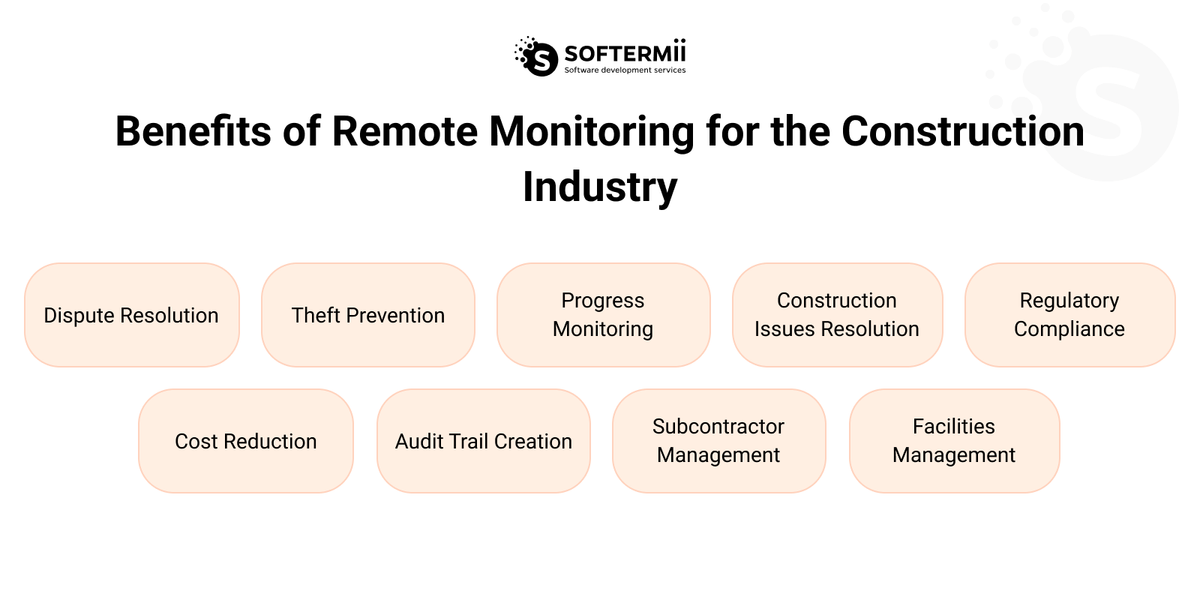
Of course, there are certain technologies and equipment for remote management of the construction site. But first of all, why do you need to monitor it remotely? Here are the main benefits of this process:
Dispute Resolution
The construction process often reaches significant scales. A bunch of contractors, subcontractors, and real estate property owners — there can be a lot of disputes between all these people about costs, timelines, etc. The transparent building site remote monitoring process ensures that all parties are informed about the construction progress.
Theft Prevention
Remote monitoring through CCTV cameras and various alarms will help avoid building site thefts. In this way, construction companies will bear significantly fewer losses.
Progress Monitoring
With remote monitoring, project managers, architects, and other employees do not need to visit the construction site to check the project’s stage. Instead, it is possible with visual documentation.
Construction Issues Resolution
Thanks to remote monitoring systems, developers have a complete picture of what is happening on the construction site. In this way, they can see and solve problems before they become critical.
Regulatory Compliance
The construction industry requires compliance with many standards. Remote monitoring and documentation of all construction processes allow you to share this information with regulators to verify compliance with all their requirements.
Cost Reduction
First, remote monitoring allows you not to spend money on frequent visits to construction sites. Secondly, data analytics software enables you to optimize budgets and identify areas where you can cut expenses.
Audit Trail Creation
Remote monitoring allows you to document everything happening with the construction project. And when you have any questions or problems, you can go back to your records to check if you missed any details.
Subcontractor Management
Large-scale construction projects involve numerous contractors and subcontractors. You can easily supervise their work thanks to remote monitoring systems.
Facilities Management
The project documentation created by you as a result of remote monitoring will be needed even after the construction process is over. You can transfer data to future tenants or property managers for faster repair work or building maintenance.
Most Useful Remote Construction Monitoring Features & Use Cases
As already mentioned, construction remote monitoring involves various technologies and equipment. Let’s talk about the main tools in greater depth:
Reports
The reporting system is integral to remote construction monitoring. These can be reports on completed work, delays in construction processes, money and time spent on purchasing materials and performing tasks, evidence gathering, inquiries, and even on-site inspections.
Machine Recognition
Such tools will ensure compliance with regulations regarding the employees’ safety and health. They include a variety of sensors and cameras, for instance, to identify a person who is not wearing a helmet, etc.
Motion Detection Systems
Motion tracking systems help prevent the theft of equipment or building materials or avert illegal entry to a construction site.
$2.5 billion
The global remote construction monitoring market is expanding quickly. It will most likely reach $2.5 billion in 2030 from $853 million in 2022.
IoT Devices
These devices, one of the trends in real estate, will be handy in the construction industry. They can be used for many purposes, for example, to check the equipment and its level of wear, to receive notifications about the need for repair or replacement of building equipment, or to detect any malfunctions.
Such tools significantly facilitate both the process of remote construction monitoring and on-site building in general.
Other Technologies for Remote Construction Monitoring
It may seem that we’ve discussed all core tools and techs that are currently prevalent in construction. Yet, more technologies are gaining popularity in this industry:
Cloud Technology
Now more and more businesses are turning to cloud solutions. The cloud can be a central repository for all construction data. Moreover, it will be possible to swiftly access this data through a web browser. When information on the construction project is easily accessible to workers, the construction process will progress faster and more smoothly.
Drone Technology
Drones, which allow you to take aerial photos and videos of the construction site, are helpful for remote construction monitoring. Moreover, you can use these devices where conventional cameras won’t work.
3D Laser Scanning
3D laser scanning can capture precise information about a construction site. Thanks to this technology, you can remotely measure any object’s depth, length, and width. All this significantly simplifies design verification, planning, and modeling.
Software Examples for Remote Construction Monitoring
As you can see, you can leverage numerous technologies in the construction field. Let’s specify them by looking at real examples of remote monitoring software for construction.
HoloBuilder
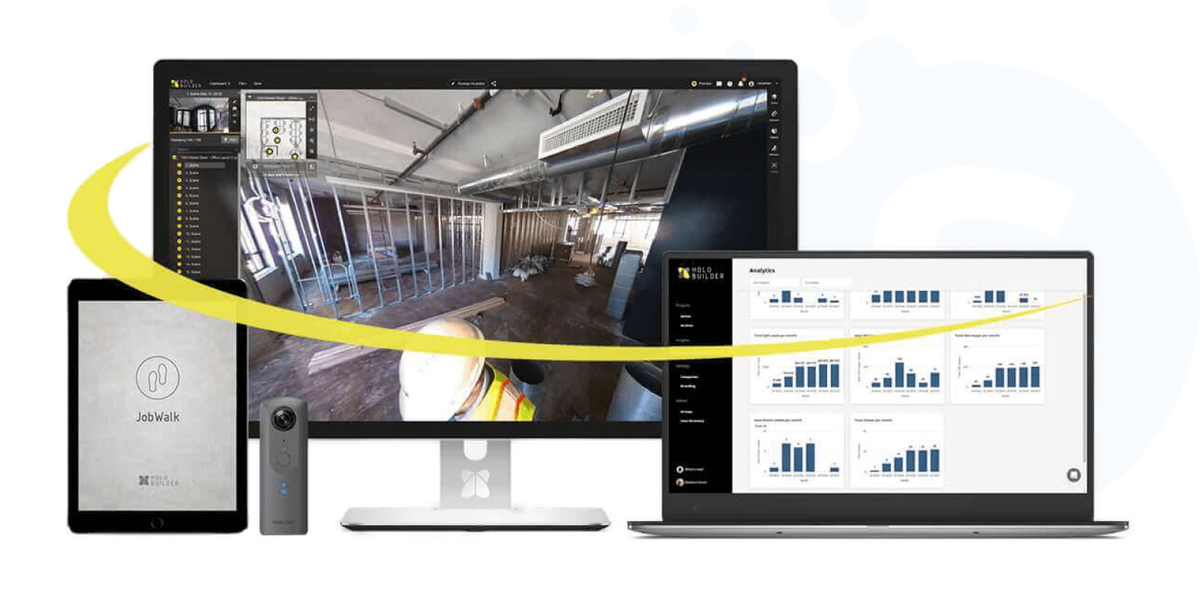
HoloBuilder is an AI-powered tool for documenting and analyzing construction progress. This platform makes it possible to create a 360° digital copy of a building object with the possibility of remote access. Thus, HoloBuilder enables automation remote monitoring in construction.
PlanRadar
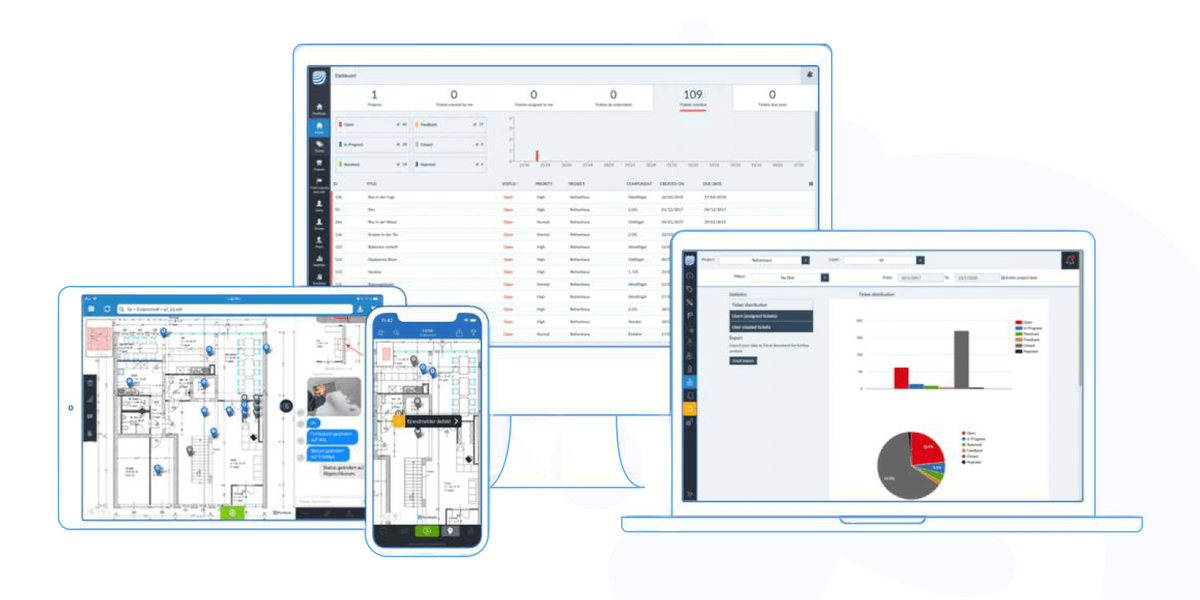
PlanRadar is remote construction monitoring software. It allows you to manage defects and create building documentation. Among the convenient features is the possibility of working in a shared environment for all project participants, which is possible thanks to cloud technologies. With PlanRadar, all construction site reports, photos, plans, etc., are available remotely.
B2W
B2W software allows on-site workers to create, edit, and send field logs. Further, with this data, you can track construction progress, manage materials and equipment, supervise subcontractors, etc.
Building Radar
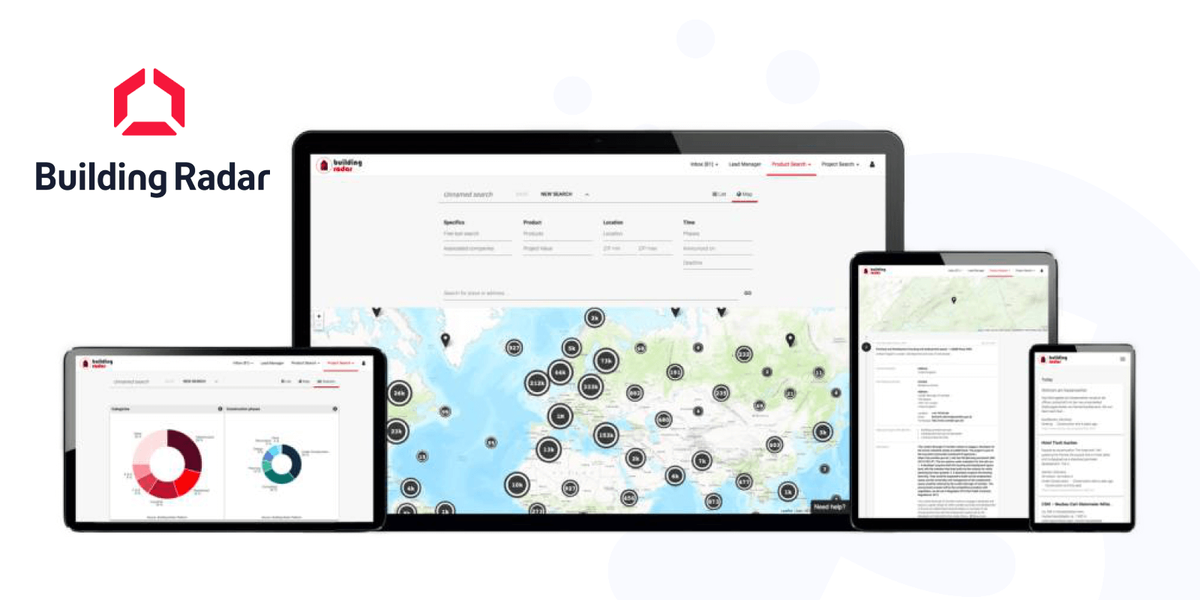
Building Radar is another software for remote construction monitoring. It detects new projects in real time and tracks their progress. In addition, thanks to Building Radar, you can view information about a project or search for construction sites in your location.
BuilderStorm
BuilderStorm is a construction tracking software that offers high flexibility. You can choose only those features necessary for your business’s tasks. This software’s core functions are project and company management and the creation and administration of project documentation.
Does It Make Sense to Build a Custom Monitoring Platform?
If, after familiarizing yourself with the most popular software for remote monitoring and construction, you haven’t yet found the one that suits you, that’s alright. You can always create an effective custom solution perfect for your business needs.
Remote construction monitoring software available on the market may not always work for every construction company. It may need more critical features and customization possibilities or be too complex and outdated.
That’s why developing such systems is relevant among construction startups. Companies can create user-friendly solutions and embed the functionalities they indeed require. On top of that, they can later profit from selling their custom construction monitoring software to other businesses.
Cost of Developing a Custom Construction Monitoring Solution
If you feel that your way is developing your own remote construction technology, then you should know how much such software will cost you.
First of all, keep in mind that the following factors determine the cost of software:
- Number and complexity of features
- Selected tech stack
- The size of the development team and their salary rates
Now let’s look at the step-by-step process of developing remote construction monitoring software and calculate the approximate cost of each step:
Steps
Discovery & Research stage
Time: 280 hours
Cost: $11 200
At this stage, your business analysts study your software requirements, determining its main goals, strengths, and weaknesses. Your team also researches the market, your competitors, and your target audience.
It’s also the time when our design team creates a prototype and a concept. When creating the platform’s UI and UX prototypes, our team assesses to what extent the technology stack, functions, and overall aesthetics meet the client's expectations.
[[$banner-blog-link? &banner-text=`Among the benefits of remote monitoring are construction issues and dispute resolution, theft prevention, progress monitoring, regulatory compliance, cost reduction, audit trail creation, subcontractor and facilities management.`]]
Development
Time: 640 hours
Cost: $25 600
At this stage, your backend developers work on the server part of the remote construction monitoring system, and frontend specialists handle the client side. Finally, developers join designers to deliver a working product version.
Testing and launching
Time: 240 hours
Cost: $9 600
The testing and launching stage is crucial when you decide to build a remote monitoring solution. It is essential to collect user feedback about the product to improve the application's functionality, make it more user-friendly, and exclude bugs.
Writing technical documentation
Time: 40 hours
Cost: $1 600
It is the last step of developing a remote construction monitoring solution. It includes creating all the documentation for the application, particularly the product manual.
Let's summarize all of these in the table below:
| Development Stages | Hours | $ | |
|---|---|---|---|
| 1 | Discovery & Research | 280 hours | $11 200 |
| 2 | Development | 640 hours | $25 600 |
| 3 | Testing | 240 hours | $9 600 |
| 4 | Creating technical documentation | 40 hours | $1 600 |
| Total | 1 200 hours (5 month) | $48 800 |
Note, that this is just an approximate cost breakdown and the final price of the remote construction technology may vary depending on the number of features, team composition, deadlines, etc. So, if you want a precise calculation, contact us for a free quote.
Final Thoughts
Remote monitoring in construction is a real revolution. Technology allows construction workers to easily solve various issues without visiting the building site. They can also conveniently monitor progress and optimize budgets.
If you also need remote monitoring software to streamline your construction process, Softermii can help. We have considerable experience in developing monitoring systems and software for real estate. So, feel free to leverage our extensive background and contact our team.
Remote monitoring software available on the market may not always work for every construction company. Thus, you may need custom software development .
Frequently Asked Questions
Why is remote monitoring essential for every construction site?
Remote monitoring helps in many aspects. Thanks to technologies and devices, it is possible to prevent theft and break-ins, ensure regulatory compliance of construction processes, manage employees more efficiently, keep all construction data in one place, and solve many construction-related issues.
What problems does remote construction monitoring solve?
Remote construction monitoring solves numerous issues. For example, it helps ensure the safety of workers on the construction site, track equipment, and construction materials, and reduce misunderstandings between contractors, subcontractors, property owners, etc.
How do you find and hire experts developing remote monitoring systems for construction?
To choose reliable specialists, you need to check whether they have experience in the construction niche. Also, see if they have developed similar software, even if it is remote patient monitoring systems. Next, you need to conduct an interview and make sure that the vendor meets your requirements.
How long do software solutions for remote construction monitoring pay off?
It all depends on the cost of this software. If you choose an inexpensive, available solution, it will pay off very quickly. It will take some time to pay off if you have invested in developing a custom one. However, considering all the benefits you’ll get, it’s worth it.
How about to rate this article?
303 ratings • Avg 4.8 / 5 · Thanks for rating!
Written by:

CEO & Co-Founder
Slava Vaniukov is the CEO and Co-Founder of Softermii, with more than 10 years on the front lines of software development. He has spent that decade helping founders and enterprises turn ambitious ideas into products that ship — and that perform. Apps built by his teams have been featured on multiple “Top 10 Best App…