

Want to know more? — Subscribe
The days of looking for jobs on the streets or in newspapers are gone. It’s more likely that modern employment seekers will view available offers online, for…
The days of looking for jobs on the streets or in newspapers are gone. It’s more likely that modern employment seekers will view available offers online, for example, on staffing platforms as a service.
A Glassdoor study showed that 53% of candidates use job search websites to explore vacancies and 35% employ platforms for professional networking. Only 32% use personal channels for such purposes.
On top of these stats, the global staffing agency software market shows significant annual growth. From $418 million in 2022, it will reach over $772 million in 2029. Do you still need more evidence that online staffing platform development is a worthy effort?
Become a part of this sought-after software niche by learning how to make a digital staffing platform. We, in turn, will share the main reasons for creating such a product, its core features, tech stack, and challenges you may encounter during development.
Softermii has a profound experience in recruitment and staffing platform development and, thus, can reveal all characteristics of this process. We also suggest you dive deeper into this matter following the example of our Locum App product.
Want a skimmable version?
Get a quick overview of our article with AI to access all the important information quickly.
Generate AI SummaryHide summary
Want a skimmable version?
Get a quick overview of our article with AI to access all the important information quickly.
Generate AI SummaryHide summaryHow to create an online staffing platform — why to build one, how it differs from a job board, and the features for employers and seekers.
Why You Should Build Your Own Staffing Platform
Recruitment software can benefit both HR specialists and job seekers. The first ones get a streamlined hiring process and convenient communication with candidates. For the latter, it means a quick job search and instant feedback from the employer.
But why should you become a provider of such software? Here are the main reasons for building a staffing platform:
Get Substantial Profits
Staffing websites are in great demand among individual recruiters, staffing agencies, employers, and employees. You can easily monetize the experience with your online employment platform for each group of users.
For example, you can charge recruiters or employers a commission for posting and promoting jobs on your platform. Or you can offer job seekers a fee to access premium vacancies. And it’s not even mentioning earnings from advertising on your website.
Thus, a staffing platform can bring you significant profits.

Choose among 120 software specialists
Hire an offshore dedicated team or a few team members for your project. We guarantee 10% of deviation in deadlines and cost.
Hire a teamAccess an Extensive User Base
Your staffing platform gives you access to a wide audience. And if you position your product as a horizontal marketplace, that is, a website for finding work in various niches, you will generally attract an incredible number of users. Thus, the larger the audience, the greater the benefit for your company.
What is the Difference Between Online Staffing Platforms and Job Boards?
People often refer to staffing platforms as job boards. Yet, these are terms that have different meanings. Read the clear definitions before creating staffing platforms to avoid any misinterpretations.
Let’s start with job boards. It’s just what it sounds like: websites that list job vacancies from various companies. Typically, employers pay a commission for posting jobs, and service providers allow access to CVs and potential candidates.
Perhaps you are wondering, doesn’t the online staffing platform list vacancies like job boards? You would be right, but such software offers much more.
An online staffing platform is a website or application that connects employers with independent workers or freelancers. In addition to the job posting function, this software offers profiles for employers and candidates and an integrated payment system.
As a rule, staffing platforms focus on freelancers, remote workers, and part-time employees. Yet, exceptions exist.
What’s more, such websites often work in specific niches. For example, they offer access to IT experts or specialists in the creative industry. These staffing software can also focus on specific business types, such as startups or large companies.
On-Demand Staffing Platform Features
Let’s say you decided to make an on-demand staffing platform. What do you need for this? Take a look at the required functionality for your product.
Three parties will interact with the on-demand staffing app: employers, job seekers, and admin. Therefore, it’s rational to divide your software into three modules with slightly different features.
Employer Features
Let’s look at the features recruiters will need on your platform for human resources.
Company Profile
This feature will allow companies to tell more about themselves and convince potential candidates of their reliability and impeccable reputation.
Job Posting
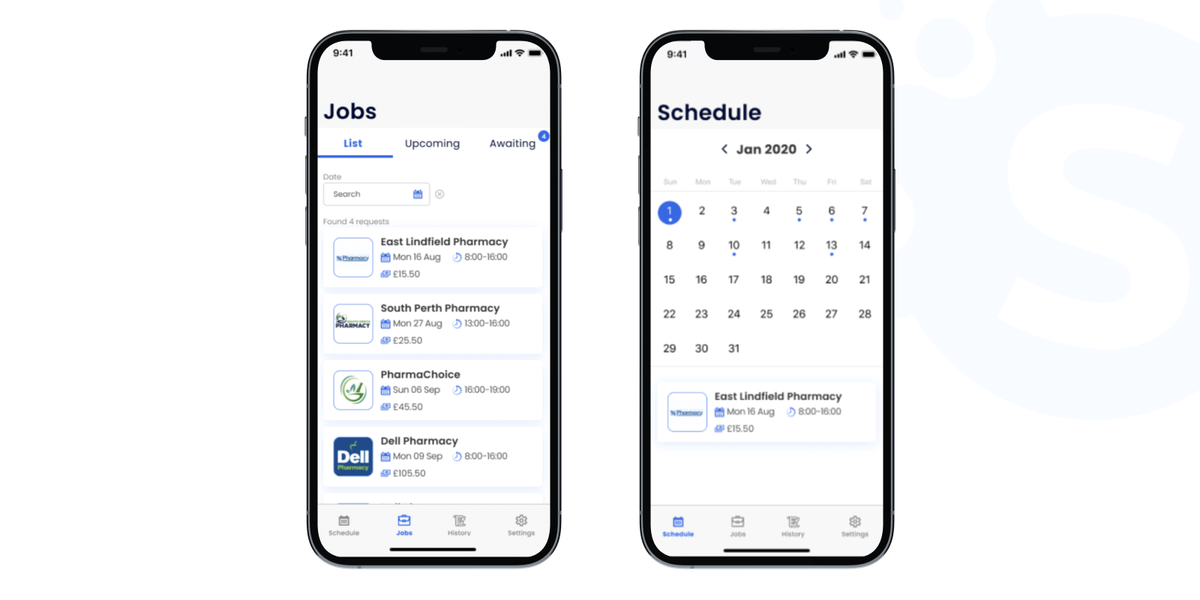
Thanks to the job posting function, companies can conveniently publish their vacancies with all the details that will attract candidates’ attention.
Employee Search
The employee search feature should give employers access to many filters. It can be a search by location, years of experience, qualifications, etc.
Assignments
Employers will need this feature after they have shortlisted candidates. This functionality allows them to send test tasks to clarify workers’ qualifications.
Scheduling
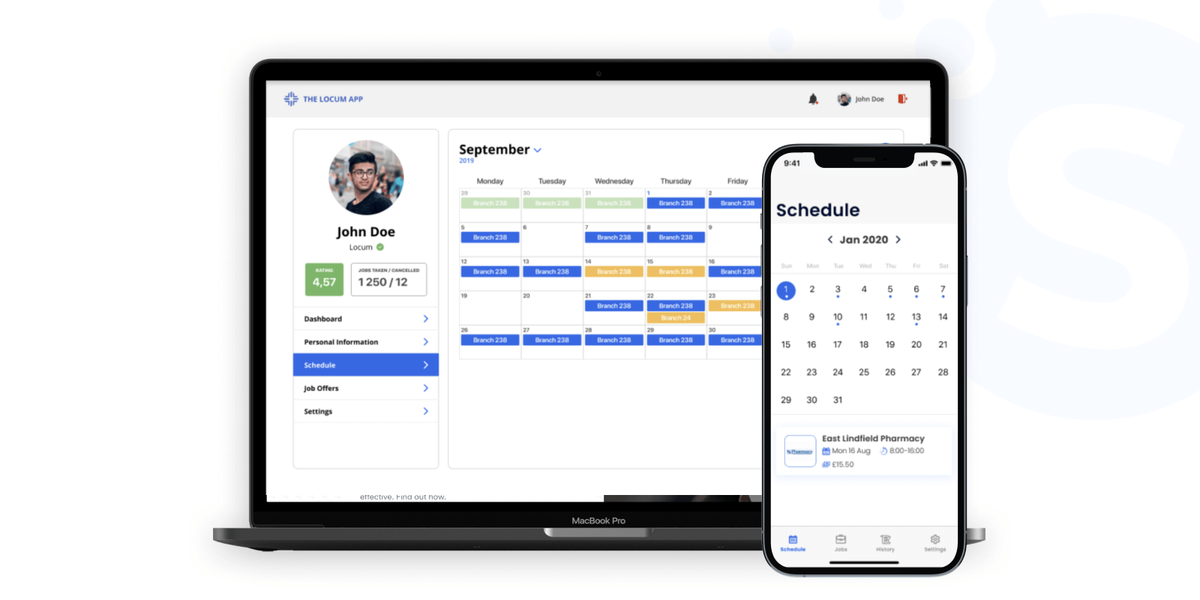
Employers will require this feature to schedule interviews or other meetings.
Recruitment
This feature on your talent acquisition and management platform will help streamline the recruiting process. It allows for employer feedback and facilitates the candidate's onboarding for the received position.
Payments
Thanks to integrated payment gateways, companies will be able to pay for the services of independent workers right on your platform.
Job Seeker Features
Let’s now look at the main functionality that job seekers need.
User Profile
This feature will allow job seekers to tell more about themselves and be an alternative to a resume. Users must be able to input data about their education, work experience, skills, etc.
Vacancy Search
Thanks to the search function, job seekers can filter vacancies and choose the ones that interest them the most.
Salary Comparison
This feature will help candidates compare their salaries in different cities or countries. In this way, employees can decide on a fair rate.
Company Ratings and Feedback
Thanks to this functionality, job seekers can ensure the company’s reliability and learn more about the working conditions in a particular firm.
Job Application
This function will allow candidates to respond to the vacancy that interests them. In addition, employees should be able to send their resumes, test tasks, etc.
53%
A Glassdoor study showed that 53% of candidates use job search websites to explore vacancies and 35% employ platforms for professional networking.
Admin Features
The admin panel is one more module needed when developing online staffing platforms. Let’s see what features you can integrate into it:
User Management
This feature will allow the administrator to monitor the actions of all users on the platform, both employers and job seekers.
User Verification
Thanks to this functionality, the admin will verify the company’s or employee’s authenticity.
Analytics
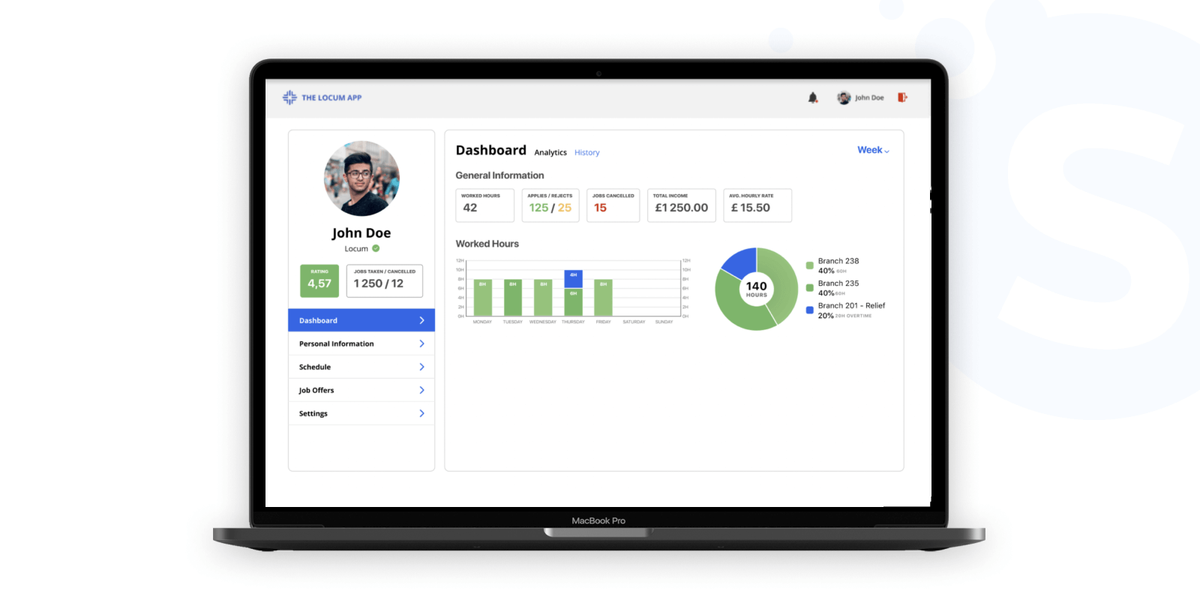
This function will enable the administrator to collect data about everything on the platform. It can be the user behavior, the number of candidates for certain vacancies, etc.
Advertisement Management
In addition, the admin must have access to manage ads on the platform. Your earnings largely depend on this.
Recommended Technical Stack for the Online Staffing Platform
As promised, we are telling you about the tech stack required for developing online staffing platforms.
So, to create such a website, you may want to use the following tools:
- Front-end development: JavaScript, React, or Angular
- Back-end development: Node.js, PHP, Java, or .NET
- Database: MySQL, PostgreSQL, or MongoDB
- DevOps: Docker, Amazon Web Services (AWS), Webpack
- Third-party integrations: Google Analytics, Elasticsearch
Other Tech Trends to Improve Your Staffing System
The technologies we listed above are just a skeleton for your online staffing platform. You can enhance it with the latest innovations in the tech industry to get the best outcomes possible.
Artificial Intelligence for Data Mining
Get deeper insights from your user data by implementing AI into your platform. This technology can analyze an incredible amount of information that no human can handle.
Based on the results you will get from the collected data, you will be able to significantly improve both the technical side of your platform and the one responsible for interacting with your users.
Machine Learning for Processing Algorithms
Many staffing platforms use outdated algorithms. As a result, candidates do not find the needed positions, and employers are left without qualified workers. If you use machine learning to process algorithms, you can significantly increase the accuracy of selecting candidates, vacancies, or employers.
Legal Compliance of an Online Staffing Platform
Before you invest in online staffing platform development, your company must resolve some legal issues. It’s critical to ensure that your software is regulatory compliant, but remember that requirements will differ significantly depending on your location.
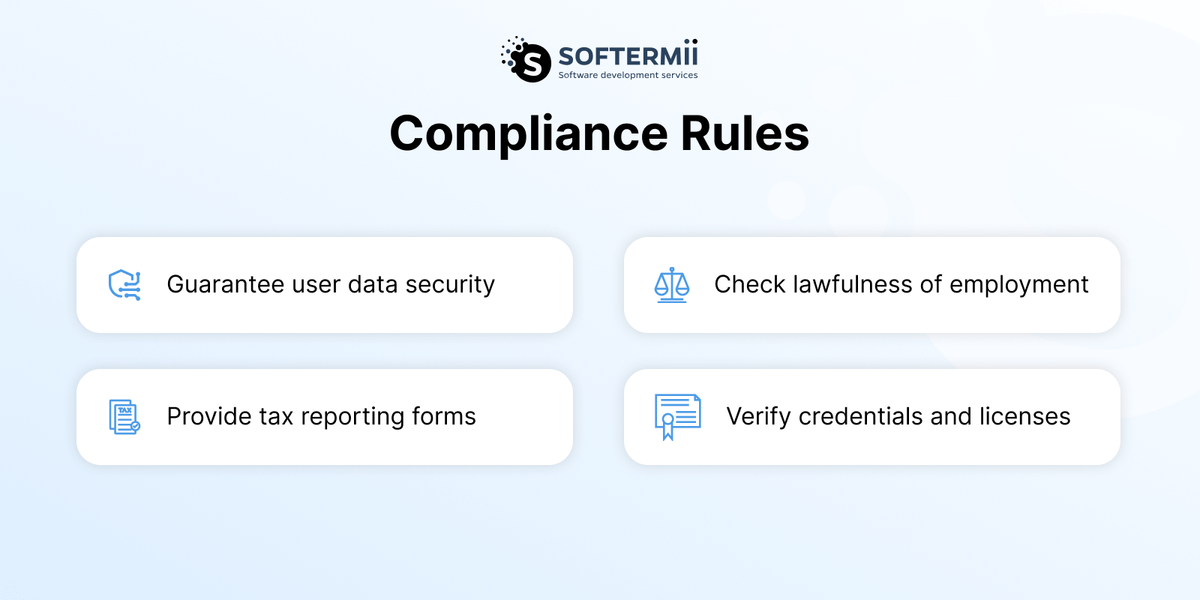
Typically, you, as a provider of a platform for staffing company, should follow these rules:
- Guarantee user data security
- Provide tax reporting forms
- Check lawfulness of employment
- Verify credentials and licenses
The rest of the obligations, such as the social security package, workers’ compensation, etc., apply exclusively to the employer and the job seeker. You act mostly as a mediator.
Frequent Challenges That Arise During Staffing Platform Development
Regulatory compliance isn’t all you need to worry about. Think also about other challenges you may face when deploying a staffing platform.
User Data Vulnerability
Both employers and job seekers will share their private information on your platform. For example, these are contact details or copies of educational credentials. This information can leak if you don’t protect it enough. As a result, your platform’s reputation may go down.
It would help to implement advanced security in your on-demand staffing app to prevent this. In addition to the more technical measures, you can consider the following tips. Don’t disclose user contact information or allow content to be copied on your platform.
Read Also: Digital Transformation in Education
Candidate Mismatch
Such a problem often occurs on online staffing platforms. For example, a candidate responded to a vacancy that initially seemed worthy and then realized that it did not suit him. Or a company receives a pile of resumes from workers with inappropriate qualifications.
In this case, you must take good care of your platform’s algorithms. As mentioned, machine learning is probably the most effective solution.
Job Postings Reliability
When building a staffing platform, consider hiring a moderator for your website. In this way, you will quickly get rid of outdated and irrelevant vacancies, and your reputation will significantly increase in front of your users.
An even better solution would be to automate this process. You can make your platform check the job posting date and status automatically.
Connecting Payment Gateways to Your Online Staffing Platform
Another thing you should consider when building a staffing platform is the integration of payment gateways. Thanks to them, employers will be able to pay for the services of workers immediately on your website.
The most popular providers of payment gateways are as follows:
- Stripe
- PayPal
- AmazonPay
- 2Checkout
You can use one of these tools or implement several payment methods simultaneously. How can you do it? Payment gateway providers give access to their APIs, so you can easily integrate such a feature into your platform.
$418 million
From $418 million in 2022, the global staffing agency software market will reach over $772 million in 2029.
Online Staffing Platform Development Cost
There are various factors influencing staffing platform development costs. Let’s get to know them better so you can plan your expenses as accurately as possible.
The first thing to consider is the development approach. For example, ready-made website templates are generally cheaper than creating staffing platforms from scratch.
Another factor that significantly impacts the final price of your online staffing platform is the number and complexity of features. Thus, the more features, the higher the price.
Don’t forget to consider the dev company’s rates as they influence the costs as well.
Here’s the stage-by-stage cost breakdown:
Discovery, evaluation, and UI/UX design stage
Time: 280 hours
Cost: $11 200
If you’re wondering how to start a staffing platform – this should be your very first step. Our business analysts conduct market research, analyze customer expectations, and assess industry trends in the first phase. All this information serves as a basis for project budget calculation.
When creating the platform’s UI and UX prototypes, our team assesses to what extent the technology stack, functions, and overall aesthetics meet the client's expectations.
Development stage
Time: 640 hours
Cost: $25 600
Our experts create an early version of the entire product based on the selected technology stack.
Testing and launching
Time: 240 hours
Cost: $9 600
The testing and launching stage is crucial when building a staffing platform. It is essential to collect user feedback about the product to improve the application's functionality, make it more user-friendly, and exclude bugs.
After all testing and bugs are fixed, your staffing software is ready to go. Remember that any service needs support even after release to compete on the market successfully.
Writing technical documentation
Time: 40 hours
Cost: $1 600
It is the last step when you develop an online staffing platform. It includes creating all the documentation for the application, particularly the product manual.
Let's summarize all of these in the table below.
| Development Stages | Hours | $ | |
|---|---|---|---|
| 1 | Estimation, Research & UI/UX design | 280 hours | $11 200 |
| 2 | Development | 640 hours | $25 600 |
| 3 | Testing | 240 hours | $9 600 |
| 4 | Creating technical documentation | 40 hours | $1 600 |
| Total | 1 200 hours (5 month) | $48 800 |
However, that’s just the cost of the simplest online staffing platform development. The price may change greatly if you decide to add more features and to make the design, highlighting the uniqueness of your brand. If you want more precise calculations, drop us a line and our specialists will come back to you with detailed plans and figures.
Softermii Experience with Online Staffing Platform Development
We are a company that has substantial experience in the modern tech market. Our staff includes over 120 developers who are well-versed in deploying technology for companies in various industries.
Furthermore, our team offers a wide range of services, namely:
- Business analysis
- Project management
- UI/UX design
- Web development
- Mobile app development
- Software testing
- DevOps
- And more
Using our services, our clients have got more than 100 successful projects. In particular, online staffing platform development is among such cases. We want to tell you about it in more detail.
Locum App
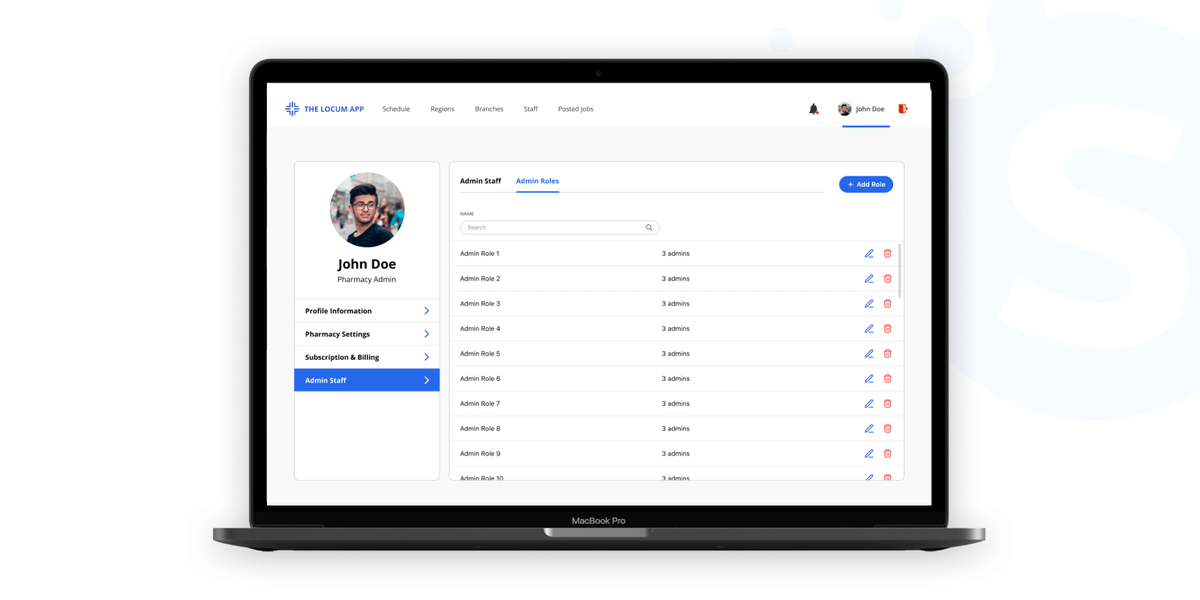
The Locum App is a mobile and web platform for recruiting pharmaceutical staff in the United Kingdom. Our product helps streamline and automate the hiring process and make it more comfortable.
Challenges we encountered:
- The complex process of hiring pharmaceutical workers in the UK, namely the shortage of personnel and the incompatibility of workers with employers’ requirements.
- The difficulty of finding job vacancies in the pharmaceutical industry.
Our solution:
- We fully automated the process of recruiting pharmaceutical personnel thanks to the following features: two separate modules for pharmacists and pharmaceutical companies; admin capabilities for each user group; fast job posting and search process; integrated locum booking.
- We also added an in-app messaging feature for instant communication between employers and candidates.
Locum App users can now quickly find jobs in the pharmaceutical niche. Our product capabilities allow you to check candidates even before they come to the interview, and therefore it significantly simplifies the selection and hiring process.
Read Also: The Latest Trends in Pharmaceutical Technologies
Final Thoughts
As you see from today’s article, creating staffing platforms can be a promising endeavor. For your business, it’s an opportunity to generate significant profits, as you can gather a large user base with such software.
Yet, you must invest much effort in building a staffing platform. At least, it’s since you have to take care of three modules for different user groups. Additionally, you need to be mindful of regulatory compliance and data security on your platform.
Perhaps the best solution for you will be to contact the staffing platform development professionals directly. In this way, you won’t need to worry about the quality of your product, and you’ll get it as soon as possible.
Speaking of an experienced software dev company, Softermii can create a staffing platform for you. If you are interested in our offer, feel free to contact our team.
Staffing websites are in great demand among individual recruiters, staffing agencies, employers, and employees. You can easily monetize the experience with your online employment platform for each group of users.
Frequently Asked Questions
What is the best development approach for a staffing platform?
You have two main approaches to building a staffing platform. You can use a ready-made solution available on the market or create your own from scratch.
Speaking about which approach you should choose, it’s worth starting from your financial capabilities and product requirements. If you have a limited budget, your choice is a ready-made solution. If you can spend some money, a custom platform from scratch will help you realize all your ideas.
How long does it take to make a digital staffing platform?
Your project timeline will vary according to its unique features, etc. But considering all the work involved, you will need at least 1,000 hours to build your own staffing platform.
Is it possible to build a staffing platform for less than $60,000?
Yes, it can be possible. For example, you can lower the final price if you change your product’s tech stack. To get the cost estimate for your case, better contact our specialists.
How about to rate this article?
181 ratings • Avg 4.5 / 5 · Thanks for rating!
Written by:

Co-Founder
Andrii Horiachko is a Co-Founder of Softermii with over 12 years of experience in software development, eight of them spent building and managing Softermii itself. He is responsible for technology-innovation in clients’ projects, making sure every product runs on a modern, carefully chosen tech stack that can sustai…